
Bachelor in Library & Information Science
March 27, 2025 2026-08-29 9:36Bachelor in Library & Information Science
Bachelor of Library & Information Science (B.Lib. I.Sc.)
Programme
Semester Pattern & Credit System
Duration
1 Year
Overview
The Bachelor of Library & Information Science (B.Lib. I.Sc.) and Master of Library & Information Science (M.Lib.I.Sc.) programme aims to develop professionally competent information specialists capable of managing libraries and knowledge centres in both traditional and digital environments. The primary objectives are:
- To provide foundational knowledge of Library and Information Science, including the principles, laws, and development of librarianship.
- To develop skills in the organization of knowledge, enabling students to classify and catalogue documents using standard systems such as Dewey Decimal Classification and Colon Classification.
- To train students in information sources and services, including reference service, bibliographic control, indexing, abstracting, and user-oriented information delivery systems.
- To impart managerial competencies in areas such as library administration, collection development, budgeting, human resource management, and evaluation of library services.
- To develop technical proficiency in library automation and digital resource management using modern tools and software such as Koha.
- To promote research aptitude and ethical practices in information handling, documentation, and dissemination.
Placement
Career Opportunities
Schools and Colleges – Government and private institutions as School Librarians and Information Officers. In college, a semi-professional assistant.
Universities – Library Assistant, Semi-Professional Assistant.
National Institutes – AIIMS, IIMs, IITs, NITs, IIITs, and other institutions of national importance.
Research Organizations – DRDO, ISRO, CSIR, ICAR, and other R&D establishments.
Corporate Sector Libraries – Knowledge Resource Centres, corporate information units, documentation centres, and knowledge management divisions in industries, multinational companies, law firms, and consultancy organizations.
Media Houses and Archival Units – News agencies, publishing houses, digital media organizations, and broadcasting institutions for archival management, information storage, content indexing, and digital preservation.
Government Services – Through SSC, State Commissions, UPSC, and State PSCs for professional and senior-level posts in ministries and national knowledge institutions.
International Institutions – Academic libraries, research institutions, and global information centres.
Outcomes
Programme Outcomes
2. Integration of Traditional and Digital Competencies: It equips learners with skills in knowledge organization, information retrieval, and the application of ICT and automation tools.
3. User-Centered and Ethical Orientation: The programme emphasizes quality service delivery, professional ethics, and responsible information management practices.
4. Foundation for Career Growth and Higher Studies: It prepares graduates for diverse employment opportunities and advanced academic pursuits in Library and Information Science.
Programme Specific Outcomes
2. Organization of Information Resources: Apply principles and techniques of classification, cataloguing, metadata creation, and indexing to ensure systematic organization and efficient retrieval of information resources.
3. Digital Library and ICT Applications: Utilize library automation software, digital library systems, institutional repositories, and online databases for effective management and dissemination of information in digital environments.
4. Information Services, Research, and Professional Development; Deliver reference, bibliographic, and information literacy services to diverse user groups while applying research methods and engaging in continuous professional learning and innovation.
Eligibility
B.Lib. I.Sc.
Bachelor’s degree in Any Discipline (10+2+3), with at least 50% marks
Intake and Duration of Courses
B.Lib. I.Sc.
20 Seats
1 Year (2 Semesters)
Admission Process
Fee
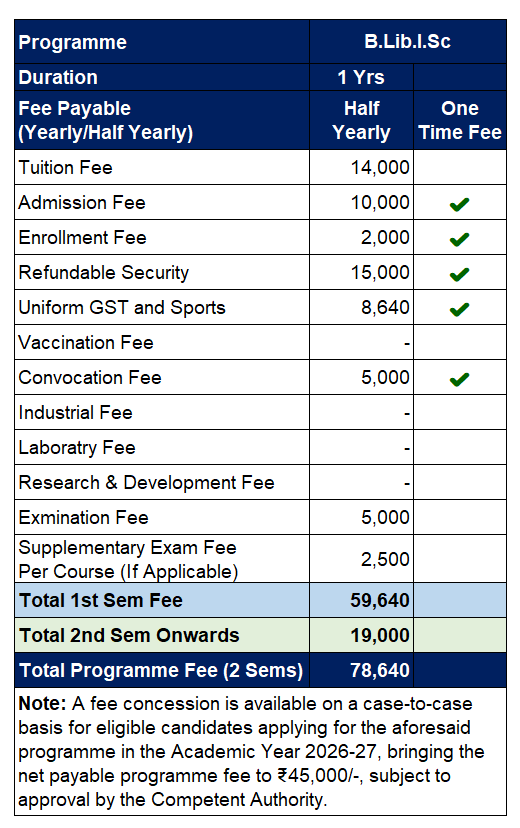
Bachelor in Library & Information Science Fee 2026
Up to 100% Merit Scholarship
Merit-Based Support
Merit-cum-Means Scholarship
Special Scholarship
Free-ship for Orphans
Legacy & Support Benefits
SRHU University
Your Future Begins Here