Policy on Radiation Safety
February 3, 2026 2026-02-03 7:38Policy on Radiation Safety
Policy on Radiation Safety
| Approved | NABH Standard 5thEdition: AAC /11 |
| Issue Date | 22nd April 2022 |
| Next Review | 2025-26 |
Controlled Copy Distribution Details:
| S.No. | Controlled Copy No. | Designation of Custodian of Controlled Copy. |
|---|---|---|
| 1 | 01 | Radiology Department |
| 2 | 02 | OT, ICU |
| 3 | 03 | All concerned Dept. |
Table of Content:
| Section No. | Content |
|---|---|
| 1 | Policy |
| 2 | Purpose |
| 3 | Definition |
| 4 | Abbreviation |
| 5 | Scope |
| 6 | Stakeholders |
| 7 | Distribution |
| 8 | Start & End Point |
| 9 | Procedure |
| 10 | References |
| 11 | Records and formats |
| 12 | Revision record sheet |
| 13 | Amendment sheet |
RADIATION SAFETY PROGRAMME
- POLICY:
Hospital shall ensure that the risk associated with imaging, interventional and surgical radiation procedures is minimized by adhering to relevant radiation protection legislations and appropriate radiation safety measured. - PURPOSE:
To ensure that risk associated with imaging, interventional and surgical radiation procedures are identified, assessed, managed and minimized. - DEFINITION:
- Annual Limit of MPD (Maximum Permissible Dose) for radiation workers: The maximum permissible annual equivalent dose for radiation workers.
- Attenuation: A reduction in intensity of radiation passing through matter due to processes such as absorption and scattering.
- Beam Hardening: The process of filtration of an X-ray beam by the preferential absorption of lower energy photons, thereby increasing the average energy of the beam.
- Collimator or Field-Limiting Diaphragm: A device used for limiting the size and shape of the primary radiation beam.
- Commissioning: The process during which structures, systems and components of a facility, having been constructed, are made operational and verified to be in accordance with design specifications and to have met the performance criteria
- Competent Authority: Any official or authority appointed, approved or recognised by the Government for the purpose of the Rules promulgated under the Atomic Energy Act, 1962.
- Decommissioning: The process by which a facility is finally taken out of operation in a manner that provides adequate protection to the health and safety of the workers, public and the environmental issue
- Filter: A radiation attenuating material incorporated in the path of the radiation beam to absorb preferentially the less penetrating components of the useful beam. It may consist of a permanent filter which is an integral part of the X-ray tube housing and which cannot be removed by the user, and/or an added filter which is intended to increase the total filter thickness.
Not used in the present-day fluoroscopy equipment.- Gantry Aperture: The physical opening in the CT scanner through which the patient is moved for the X-ray examination.
- Grid: A device composed of alternate strips of lead and radiolucent material encased and suitably placed between the patient and X-ray film to absorb scattered radiation. “Potter Bucky grid” or “Bucky” means a device containing a grid and a mechanism to impart motion to the grid during radiography exposure.
- Handle: Manufacture, possess, store, use, transfer by sale or otherwise, import, transport, or dispose off.
- Lead Equivalence: The thickness of lead, which, under specified conditions of irradiation, affords the same attenuation as the material under consideration.
- Leakage Radiation: Any radiation coming out of the source/tube housing, except the useful beam or primary beam.
- Light Beam Collimator or Light Beam Diaphragm: The mechanism to collimate and indicate the radiation field by optical means.
- Milli ampere-seconds (mAs): The product of the current through X-ray tube in mA and the duration of the exposure in seconds.
- Quality Assurance: Planned and systematic actions necessary to provide adequate confidence that an item or facility will perform satisfactorily in service as per the design specifications.
- Radiation: Gamma rays, X-rays or rays consisting of alpha particles, beta particles, neutrons, protons and other nuclear subatomic particles, but not sound or radio waves, or visible, infrared, ultraviolet light.
- Radiation Protection Survey/Radiological Survey: An evaluation of radiation safety using appropriate radiation measuring instruments.
- Radiological Safety Officer (RSO): Any person who is so designated by the employer and who, in the opinion of the competent authority, is qualified to discharge the functions outlined in the Radiation Protection Rules, 1971.
- Safety: Protection of all persons from undue radiological hazards.
- Tube Housing:
A shielding enclosure provided around an X-ray tube, in order to:- Define the useful beam; and
- Limit the radiation levels outside the useful beam so as not to exceed the radiation leakage levels as prescribed by the competent authority.
- Type Approval: Approval issued by the competent authority based on evaluation of the device to ensure that it conforms to safety standards.
- Useful Beam or Primary Beam: That part of the emergent radiation from an X-ray tube housing which is capable of being used for the purpose for which the X-ray equipment is intended.
- Worker: Any person, who works, whether full-time, part-time or temporarily, for an employer, and who has recognised rights and duties in relation to occupational radiation protection. (A self-employed person is regarded as having the duties of both an employer and worker).
- Beam Shaping (Flattening) Filter or Bowtie Filter or Bowtie Filter: An X-ray beam filter composed of a material such as graphite, Teflon or aluminium, which, when placed in the X-ray tube, more heavily attenuates peripheral portions of the X-ray beam which pass through the thinner portions of the patient. The term bowtie refers to the shape of the filter. Not used in Diagnostic Radiology.
- Cone: A device by which X-ray beam is confined to a specified area, size or dimension.
- Detector: A device element of a detector unit or array which receives X-rays and responds by producing an electrical or light signal. The entire assembly of X-ray receiver may contain a single element of a detector or an array of detectors.
- Focus: That area of the anode in an X-ray tube on which X-ray-producing electrons are incident.
- Mobile Equipment or Portable Equipment: Equipment intended to be moved or carried from one location to another between periods of use.
- X-ray Equipment or X-ray Unit: The integrated assembly consisting of X-ray tube along with its housing, supporting structures, associated accessories necessary for proper operation, and inclusive of built-in radiation safety devices.
- ABBREVIATION:
AERB Atomic Energy Regulatory Board BARC BHABA Atomic Research Centre ALARA As Low as Reasonably Achievable RSO Radiation Safety Officer GM Geiger-Muller Counter Gy Gray Pb Lead mSv millisievert TLD Thermo Luminescent Dosimeter NOC No Objection Certificate SSD Source-Skin Distance THF Tuned high frequency - SCOPE:
- The Hospital Radiation Safety program applies to all locations where radiation-producing machines are used or stored, regardless of ownership or the location.
- It applies to all persons working at or frequenting these locations, regardless of their relationship with the Hospital.
- It applies to all radiation-producing machines at these locations, regardless of ownership of the machines.
- STAKEHOLDERS:
Quality department / Radiology staff / Management - DISTRIBUTION:
Radiology Department, Quality department - START POINT: Separate for each process
END POINT: Separate for each process - PROCESS DETAILS:
This document is intended to govern radiation safety in design, installation and operation of X-ray generating equipment for medical diagnostic purposes in order to:- Ensure that radiation workers and members of the public are not exposed to radiation in excess of limits specified by the competent authority under the Radiation Protection Rules, 1971, and by safety directives issued from time to time.
- Reduce radiation exposures below these limits to levels as low as reasonably achievable.
- Ensure availability of appropriate equipment, personnel and expertise for safe use of the equipment and for patient protection.
- Ensure timely detection and prompt rectification of radiation safety-related defects or malfunctioning of the equipment.
- Radiation Safety
- All radiation workers (Radiologists, X-ray technician, Staff nurses, Radiology students) must wear monitor devices (TLD badge) when on duty. If wearing a lead apron, TLD badge should be worn under the apron.
- Routine monitoring of scattered radiation in the immediate vicinity of X-ray machine with appropriate Detector. (Radiation leakage level at 1 m from tube housing and collimator should be less than 1mGy per hour) & recorded in periodic quality assurance report.
- Equipment should have:
- Safety interlocks for tube head port / shielding.
- Visual warning about the x-ray tube is on or off.
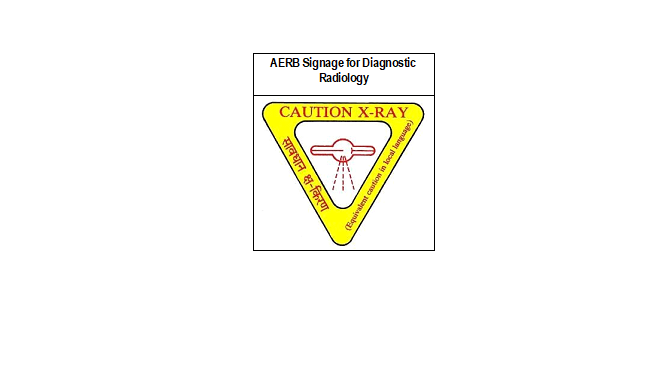
- Each room with X-ray equipment must be posted with a signage displaying “CAUTION – X-RAY EQUIPMENT”, CAUTION FOR PREGNANCY and Instructions in English and the local language (AERB Approved signage).
- Operating and emergency procedures for the machines:
- Use of employee and patient protective devices including lead aprons, lead screens, thyroid shield.
- Use of personnel dosimeter (TLD Badge).
- Personnel dosimeters should:
- Always be used during examination.
- Store them in safe places away from sources of radiation.
- Never wear another person’s dosimeter.
- If a lead apron is worn, dosimeter underneath the lead apron to be worn.
- Technique chart to be posted at control panel specifying parameters for routine examinations:
- Distance between X-ray tube and Image receptor,
- Appropriate exposure factors for each Radiographic examination,
- Not applicable in case of DR/CR system.
- Maintain records of:
- Maintenance,
- Repairs,
- Modifications performed on each X-ray machine,
- Name of the individual performing the service,
- Date performed.
- Personal Protective Equipment:
- Lead Aprons (0.50 mm Lead),
- Thyroid Shields (0.50 mm Lead),
- Lead Goggles (0.35 mm Lead),.
- Abdominal Shield (0.50 mm Lead),
- Lead Glasses (0.50 mm Lead),
- Lead Screen 6 X 3 Feet (Mobile) (2mm Lead) (1.5mm Pb serves the purpose for diagnostic energies),
- 2mm Lead Lined Doors in all X-ray Producing units (1.5mm Pb serves the purpose for diagnostic energies),
- A method to observe the patient during the x-ray exposure (Lead glass) shall be provided for all units,
- Lead Gloves (0.35 mm Lead),.
- Gonad shield (0.5 mm Lead).
- Safety of patient:
- Appropriate Personal protective equipment shall be kept available at all times, personnel shall be trained in their use,
- Clear all staffs from room during Mobile X-ray /Provide Lead apron to the next Bed patient if he he/she is not able to move,
- When a patient must be provided with auxiliary support during a radiation exposure and Mechanical holding devices are insufficient; the following procedures shall be followed:
- Radiographers not to hold the patient during a radiation exposure, except in a life-threatening situation.
- If a patient must be held during the X-ray exposure, non-radiation workers such as nurses or members of the patient’s family may be asked to perform this duty and he/she should be given lead clothing.
- Gonad shielding of not less than 0.5 mm lead equivalent shall be used on a patient during Radiographic procedure, except for cases in which this would interfere with Diagnostic procedure.
- The Bed roll of C.T. Scan Table shall be changed for each patient to prevent any kind of cross Infection/contamination.
- X-ray bed roll will be provided for Infectious patients.
- If a patient must be held during X-ray, the assistant holding the patient will were a lead-lined apron during the entire procedure.
- Patients such as children and pregnant women shall be shielded.
- All expectant females if necessary to be X-rayed will be properly shielded and the X-ray beam collimated to the area of interest only.
- Pregnant females will not be permitted in the X-ray room during exposure.
- No abdominal area radiographic imaging shall be performed on a pregnant or potentially pregnant patient without the approval of a qualified physician. If the X-ray procedure includes the abdominal region of the pregnant or potentially pregnant patient, the examination shall not be performed without approval from a diagnostic radiologist.
- Although it is the responsibility of the referring physician to determine pregnancy status, those operating diagnostic X-ray equipment will ask all patients of childbearing age whether or not they are pregnant and the date of their last menstrual period. The 10 days rule should be applied to all female patients of reproductive capacity. This information is to be recorded on the study requisition prior to examination. The same procedure is also applied to female attendants accompanying the patient/child in the imaging area.
- If the X-ray procedure does not include the abdomen or pelvis of the pregnant or potentially pregnant patient, the abdominal region should be shielded with at least 0.25 mm (optimally 0.5 mm) lead equivalence, and the examination performed without regard to pregnancy.
- Special precautions, consistent with clinical needs, should be taken to minimize exposure of the embryo or foetus in patients known to be or suspected of being pregnant.
- Mobile equipment should be used only for examinations where it is impractical to transfer patients to permanent radiographic installations.
- Mechanical supporting or restraining devices shall be used when a patient or film must be held in position for radiography. If a patient must be held by an individual, that individual shall be protected with appropriate shielding devices of at least 0.25 mm lead equivalence for whole body protection and at least 0.5 mm lead equivalence for any part of the holder’s body that is exposed to the primary X-ray beam.
- The minimum source-skin distance (SSD) for all mobile radiographic x-ray units must be 30 centimetres.
- During mobile radiography, the radiation worker should be at least 2 m (approximately 6 feet) from the X-ray tube.
- Radiographic examinations of all paediatric patients including neonatal from ICU must be justified by the referring physician
- Paediatric radiographic examinations should be performed very carefully with appropriate exposure factors, proper collimation and by covering sensitive organa with adequate shielding. In digital radiography, always select paediatric protocol.
- CT system is already equipped with AEC (Automatic Exposure Control), however, radiation dose to eyes, breasts and gonads should be minimized by using shielding devices according to feasibility.
- Safety of staff:
- During radiographic exposure, the operator shall stand behind the protective barrier.
- The operator should stand behind the barrier provided for his/her protection during radiographic exposures at permanent radiographic installations and should stand as far as possible (at least 6 feet) from the patient when operating the mobile equipment.
- Appropriate personal protective equipment (Radiation Protective devices) is to be worn where there is a risk of Radiation exposure.
- Personnel monitoring devices should always be worn when working with radiographic equipment. The devices worn should be those issued for the current time period and should be worn under the lead apron. Those workers wearing TLD badges should ensure that the Card has been properly inserted into the Cassette holder.
- Each mobile radiographic equipment operator, prior to making an exposure, should ask anyone within 6 feet of the X-ray tube and/or patient being radiographed to move further away until the exposure is complete.
- Radiation exposure of all individuals routinely working with sources of radiation is monitored with a TLD (Thermo Luminescent Dosimeter) badge. The devices are checked quarterly.
- Lead Apron Inspection /Radiation Protective Device:
- Lead aprons must be used to protect staffs and patients from unnecessary radiation exposure from diagnostic radiology procedures.
- Health care organization must perform inspections on medical equipment, including lead aprons, lead protective devices etc.
- Inspection Frequency
- Monthly: The Inspection consists of visual check to look for obvious tears, cuts, or etc.
- Bi annually: Apron must be placed on the table and checked using the automatic brightness control (Digital Radiography/fluoroscopic method).
Aprons must be stored properly in hangers.
- POLICY:
Do not fold or pile up.
Check for cracks.
- SAFETY SPECIFICATIONS FOR MEDICAL DIAGNOSTIC X-RAY EQUIPMENT AND PROTECTIVE DEVICES as per AERB:
- General Purpose Radiographic Equipment:
- Tube Housing
Every housing for medical diagnostic X-ray equipment shall be so constructed that leakage radiation through the protective tube housing in any direction, averaged over an area not larger than 100 cm2 with no linear dimension greater than 20 cm, shall not exceed an air kerma of 1 mGy in one hour at a distance of 1.0 m from the X-ray target when the tube is operating at the maximum rated kVp and for the maximum rated current at that kVp. There shall be a distinctly visible mark on the tube housing to indicate the plane of focus. - Beam Limiting Devices
Tube housing for stationary and mobile diagnostic X-ray units shall be provided with light beam collimators. These collimators shall comply with the leakage radiation level prescribed for tube housing. - Beam Filtration
- The minimum total filtration in useful beam for maximum rated operating tube potential shall be as per the following table:
TABLE: MINIMUM TOTAL FILTERATION FOR X-RAY TUBES:
- The minimum total filtration in useful beam for maximum rated operating tube potential shall be as per the following table:
- Tube Housing
- General Purpose Radiographic Equipment:
| Maximum rated tube potential (kVp) | Minimum total filtration (mmAl) |
|---|---|
| Less than 70 | 1.5 |
| 70 to and including 100 | 2.0 |
| Above 100 | 2.5 |
- Total filtration shall be indicated on the tube housing. The total permanent filtration in the tube shall be not less than 1.5 mm Al.
- Tube Positioning
X-ray unit shall have facilities for tube positioning, target-to-film distance selection, useful beam centring and angulation, positioning of the patient and the X-ray film for exposure in the desired manner, and appropriate features to display the same. - Locking Devices
Tube housing and tube support shall have appropriate locking devices to immobilise the tube in the desired location and orientation - Bucky Alignment
X-ray table shall have provisions for correct positioning of the grid, the bucky tray and the film cassette in proper alignment with the useful beam and for their locking in the desired position. - Cable Length
X-ray unit shall be provided with electrical cables of sufficient length so that the control panel/operation switch can be located and operated from a minimum distance of 3 m from the nearest position of the X-ray tube. For mobile/portable X-ray equipment the cable length shall be not less than 2 m. - Control Panel
Control panel shall be provided with means to indicate and control exposure parameters, including tube potential, time of exposure, tube current, and integral exposure in milliampere-seconds (mAs). It shall also provide facilities for technique selection and the engagement of the Bucky mechanism. A clearly marked and identifiable indicator shall be provided at the control panel to show whether the X-ray beam is ‘ON’ or ‘OFF’. For portable/mobile units appropriate indication of exposure parameters shall be provided. - Common Station
When more than one tube can be operated from a single control panel, there shall be indication at or near the tube housing and on the control panel showing which of the tubes is being operated. - Exposure Switch
Control panel shall have provision to terminate X-ray exposure automatically after a pre-set time or manually at any moment before this time by removing pressure from it. When mechanical timers are provided, repeated exposures shall not be possible without resetting the timer. The timer shall be capable of accurately reproducing short exposure of 0.05 second and its maximum range of exposure shall not exceed 5 second. The exposure device shall be so arranged that inadvertent exposure is not possible.
- Dental X-Ray Equipment:
- Tube Housing
Tube housing shall conform to leakage radiation levels prescribed for radiography equipment in point a. - Beam Filtration
Beam filtration requirements shall be the same as given in point c. - Focus-to-Skin Distance
- Dental X-ray assemblies for use with intra-oral films shall be provided with dental cones ensuring the minimum focal spot to skin (FSD) distance as given in the following table:
TABLE: MINIMUM FOCAL SPOT TO SKIN DISTANCES FOR DENTAL X-RAY ASSEMBLIESMaximum rated tube potential (kVp)) Minimum focus-to-skin distance (cm) Between 50 and 60 10 Above 60 and up to and including 75 20 Above 75 30 - In case of orthopan tomography (OPG) equipment for dental panoramic tomography, the focus-to-skin distance shall be not less than 15 cm.
- Dental X-ray assemblies for use with intra-oral films shall be provided with dental cones ensuring the minimum focal spot to skin (FSD) distance as given in the following table:
- Dental Cones
- X-ray tube shall be provided with such cones that will limit the beam diameter to less than 7.5 cm at the distance specified at the cone end. Interchangeable cones with built-in diaphragm shall be marked with the diameter of cross-section of the useful beam at FSD. The cone shall provide the same degree of protective shielding as specified for leakage from housing in point a.
- In case of OPG, the protective shielding to attenuate the transmitted radiation shall form an integral part of the equipment.
- Control Panel
Control panel shall be provided with means to indicate and control the exposure parameters such as tube potential (kVp), tube current (mA), and beam “ON” and “OFF”. - Cable Length
X-ray unit shall be provided with an electrical cable, which shall be connected to the operating switch at its end. Its length shall be such that the operating switch can be operated from a minimum distance of 2 m from the nearest position of X-ray tube.
- Tube Housing
- Mammography X-Ray Equipment:
- Tube Housing
Tube housing shall be so constructed that leakage radiation averaged over an area of 100 cm2, with no linear dimension greater than 20 cm and located at 5 cm from any point on the external surface of X-ray tube housing, does not exceed 0.02 mGy in any one hour. - Beam-Limiting Devices
- Tube housing shall be provided with such removable beam-limiting device that at any target-to-receptor distance specified for the unit, the beam size shall not exceed that of the image receptor next to the chest wall by 2% of the target-to-receptor distance and shall also not exceed beyond any other edge of the receptor. The beam-limiting device shall be provided with sufficient shielding to reduce the radiation level of primary beam as specified for the tube housing in
- The image receptor support shall be such that transmitted dose, when operated at the maximum rated kVp and the maximum rated current at that kVp, is less than 1 Gy per exposure at 5 cm beyond the support with no breast present. The device shall bear on its external surface clearly visible permanent markings stating the image receptor size and the target-to-receptor distance for which the device is designed.
- Beam Filtration
The total filtration in the useful beam shall be not less than 0.03 mm of molybdenum for screen-film mammography for Mo-W alloy target type and 0.5 mm of aluminium for xeromammography for W-target X-ray tubes. If an edge filter is used, the attenuation equivalent shall be given for the low energy side of absorption edge. The total permanent filter and attenuation equivalent shall be indicated on the tube housing. - Tube Positioning
Sub-section 8.6.1 d. shall apply. - Locking Devices
Sub-section 8.6.1 e. shall apply. - Cable Length
X-ray unit shall be provided with an electrical cable of sufficient length so that the control panel/operation switch can be located and operated from a minimum distance of 3 m from the nearest position of X-ray tube. - Control Panel
Control panel shall be provided with means to indicate control and exposure parameters including tube potential, exposure time and tube current/integral exposure in mAs. A clearly marked and identifiable indicator shall be provided at the control panel to show whether the X-ray beam is “ON” or “OFF”. - Exposure Switch
Control panel shall have provision to terminate X-ray exposure automatically after a pre-set time or manually at any moment before this time by removing pressure from it. Pre-set time shall be such that it shall assure a net optical density (OD) within ± 0.15 OD on the films necessary for a clear X-ray of breast. When mechanical timer is provided, repeated exposures shall not be possible without resetting the timer.
The timer shall be capable of accurately reproducing short exposure of 0.05 s and its maximum range of exposure shall not exceed 5 s. The exposure device shall be so arranged that inadvertent exposure is not possible. - Breast Compression Device
A device for maintaining firm breast compression shall be provided to assure uniform thickness of the compressed breast. The degree of compression shall be smoothly adjustable and shall remain at the set level during exposure. The compression plate shall not attenuate the beam by more than 2 mm tissue equivalent material.
- Tube Housing
- Computed Tomography (CT) Unit:
- Tube Housing
Sub-section 8.6.1 a. shall apply. - Beam-Limiting Devices
>The tube housing shall be provided with beam-limiting devices so that unattenuated primary beam at the plane of detector shall not exceed the useful dimension of detector by more than 20%. - Beam Filtration
Tube housing shall be provided with filter for both beam-hardening and beam-flattening (bow-tie filter). - Scan Plane Visualizer
A scan plane visualisation device shall be provided to indicate directly or indirectly the position of slice plane(s) (tomographic plane or a reference plane offset from the tomographic plane) on the patient within ± 2 mm. - Couch Position Accuracy
The accuracy of positioning of the patient couch shall be ± 2 mm and independent of the direction of motion of the couch. - Beam-ON Indicators
Visual indicators shall be provided on the control console and on the gantry of the scanning system to indicate whether X-ray scanning is in progress. Indicators on the gantry housing of the scanning mechanism shall be discernible from any point external to the patient side of the gantry. - Scan Increment Accuracy
The deviation of indicated scan increment from actual scan increment shall not exceed ± 0.5 mm with a weight of 100 kg simulating a human body on the patient couch. - Gantry Aperture Clearance
Gantry aperture clearance at the extremes of tilt shall permit the scanning of at least a 50 cm thick patient. - Image Receptor
Housing and supporting plates of image receptor of a CT system shall provide shielding equivalent to at least 2 mm lead for 100 kVp. From 100 to 150 kVp an additional lead equivalent of 0.01 mm per kVp shall be required. The lead equivalence shall be clearly stated on the equipment. - Visual Indicators
CT conditions of operation to be used during a scan or scan sequence shall be indicated prior to initiation sequence. For equipment having all or some of these conditions of operation at fixed values, this requirement shall be met by permanent markings. Indication of CT conditions of operation shall be visible from any position from which scan initiation is possible. - Timers
Means shall be provided to terminate X-ray exposure automatically as soon as the selected scan has been completed or in the event of equipment failure affecting data collection. Means shall also be provided so that the operator can terminate the X-ray exposure at any time during a scan or a series of scans under X-ray system control of greater than 0.5 second duration. A visible signal shall indicate when the X-ray exposure has been terminated through these means, and manual resetting of the CT conditions of operation shall be required prior to initiation of another scan. A back-up timer or device shall also be provided to monitor equipment function, and if the timer fails, it shall terminate the exposure at 110 percent of set value of total scan time. - Warm-up Conditions
Initiation of an exposure shall not be possible if the scanning motor fails to start, unless warm-up conditions are met or a localisation exposure has been selected. If the warm-up facility is provided on a CT system, there shall be a clear indication on the control panel when the warm-up mode has been selected, and there shall be a device which de-energises the X-ray tube on completion of the desired warm-up phase.
- Tube Housing
- Fluoroscopy X-Ray Equipment:
- Fluoroscopy Tube Housing and Filtration
Tube housing shall conform to leakage radiation levels prescribed for radiography equipment in sub section:- The useful beam shall have a total filtration of not less than 2.0 mm aluminium for general fluoroscopy.
- Protective Lead Glass
Protective lead glass covering of the fluorescent screen shall have a lead equivalent thickness of 2.0 mm for units operating up to 100 kVp. For units operating at higher kilo voltages the lead equivalence shall be increased at the rate of 0.01 mm per kVp. - Lead Rubber Flaps
X-ray table and fluoroscopy screen shall be provided with means of adequate protection for the radiologist and other staff against scattered X-rays. Protective flaps having lead equivalence of not less than 0.5 mm and sufficient dimensions to protect the radiologist shall be so provided that they are suspended (a) from the bottom of the screen such that the flaps overlap the fluoroscopic chair in vertical fluoroscopy, and (b) from the edge of the screen, nearest to the radiologist, such that the flaps extend down to the table top in case of horizontal fluoroscopy. The ‘Bucky-slot’ shall be provided with a cover of 0.5 mm lead equivalence on the radiologist’s side. - Tube-Screen Alignment
X-ray tube and fluoroscopic screen shall be rigidly coupled and aligned so that both move together synchronously and the X-ray beam axis passes through the centre of the screen in all positions of the tube and screen. - Field Limiting Diaphragm
Tube housing shall be provided with a field-limiting diaphragm. Its control mechanism shall be so mechanically restricted that even when the diaphragm is fully opened and the screen is at the maximum distance from the table, there is still an illuminated margin of at least 1 cm all along the edges of the screen. The diaphragm control knobs shall be located on the frame of the fluorescent screen and provided with local shielding of at least 0.25 mm lead equivalence. - Focus-to-Table Top Distance
The focus-to-table top distance shall be not less than 30 cm for fluoroscopy units. - Fluoroscopy Timer
The unit shall have a cumulative timer and its maximum range shall not exceed 5 minutes. There shall also be provision for an audible signal at the end of the pre-set time - Foot-Switch and Visual Indicator
A foot-operated pressure switch shall be provided for conducting fluoroscopy examinations. There shall be a visual indication on the control panel when the beam is “ON”. - Table-Top Exposure
The air kerma rate measured at table top for the minimum focus-to-table top distance shall be as low as possible, and in any case shall not exceed 5 cGy per min - Control Panel
Sub-section g. of 8.10.3 shall apply.
- Fluoroscopy Tube Housing and Filtration
- Radiation Protection Devices :
- Protective Barrier
The protective barrier between operator/control panel and X-ray tube/ patient shall be of appropriate size and design to shield the operator adequately against leakage and scattered radiation. It shall have a minimum lead equivalence of 1.5 mm. A viewing window of approximately 1.5 mm lead equivalence shall be provided on the barrier. Lead equivalence shall be indicated on the barrier as well as on the viewing window. - Protective Aprons
Protective aprons shall have a minimum lead equivalence of 0.25 mm and their size/design shall ensure adequate protection to the torso and gonads of the radiologist against scattered radiation. - Protective Gloves
Protective gloves shall have a minimum lead equivalence of 0.25 mm and the design shall ensure adequate protection against scattered radiation reaching the hands and wrists and shall permit easy movements of hands/ fingers. - Gonad Shield
Gonad shields shall have a minimum lead equivalence of 0.5 mm. - Vehicle-Mounted X-ray Equipment
X-ray units installed in a mobile van or vehicle, e.g. for medical surveys/ clinics in remote areas, shall be provided with an appropriate shielding enclosure to ensure adequate built-in protection for persons likely to be present in and around the vehicle. - Shielding Continuity
Appropriate overlap of shielding materials shall be provided at the joints or discontinuities so as to ensure minimum prescribed shielding all over the surface of all radiation protection devices. Care shall be taken to ensure that lead or any other shielding material does not creep or flow, resulting in reduction of shielding in any location. - Markings
Lead equivalence of shielding incorporated in radiation protection devices shall be marked conspicuously and indelibly on them. - Immobilisation
Facilities for immobilisation of patients, especially children, shall be provided so as to minimise holding of patients during X-ray examinations. - Miscellaneous Accessories
Additional radiation protection devices, which would be necessary for specialised radiological investigations, shall have a minimum of 0.5 mm lead equivalence. - Conventional Safety
Appropriate equipment shall be available to prevent/manage conventional hazards such as fire, flooding and electrical emergencies. Electrical lines to the X-ray unit shall be separated from lines to other utilities. Fire alarms and all electrical features shall comply with the safety regulations.
- Protective Barrier
- ROOM LAYOUT FOR AN X-RAY INSTALLATION:
- Location of X-Ray Installation
Rooms housing diagnostic X-ray units and related equipment shall be located as far away as feasible from areas of high occupancy and general traffic, such as maternity and paediatric wards and other departments of the hospital that are not directly related to radiation and its use. In case the installation is located in a residential complex, it shall be ensured that:- Wall(s) of the X-ray rooms on which primary X-ray beam falls is (are) not less than 35 cm thick brick or equivalent,
- Walls(s) of the X-ray room on which scattered X-ray fall is (are) not less than 23 cm thick brickor equivalent, and
- There is a shielding equivalent to at least 23 cm thick brick or 1.7 mm lead in front of the door(s) and windows of the X-ray room to protect the adjacent areas, either used by general public or not under possession of the owner of the X-ray room.
- Layout
The layout of rooms in an X-ray installation shall be such that the number of doors for entry to the X-ray rooms shall be kept to the minimum. The unit shall be so located that it shall not be possible to direct the primary X-ray beam towards dark room, door, windows, and control panel, or areas of high occupancy. - Room Size
The room housing an X-ray unit shall be not less than 18 m2 for general purpose radiography and conventional fluoroscopy equipment. The size of room housing the gantry of the CT unit shall not be less than 25 m2. Also, not more than one unit of any type shall be installed in the same room, and no single dimension of these X-ray rooms shall be less than 4 m. - Shielding
Appropriate structural shielding shall be provided for walls, doors, ceiling and floor of the room housing the X-ray unit so that doses received by workers and the members of public are kept to the minimum and shall not exceed the respective annual effective doses as prescribed by the competent authority. Appropriate shielding shall also be provided for the dark room to ensure that the undeveloped X-ray films are not exposed to more than 10 Gy per week. - Openings and Ventilation
Unshielded openings in an X-ray room for ventilation or natural light shall be located above a height of 2 m from the finished floor level outside the X-ray room. - Illumination Control
Rooms housing fluoroscopy equipment shall be so designed that adequate darkness can be achieved conveniently, when desired, in the room. - Control Panel
The control panel of diagnostic X-ray equipment operating at 125 kVp or above shall be installed in a separate room located outside but contiguous to the X-ray room and provided with appropriate shielding, direct viewing and oral communication facilities between the operator and the patient. In case of X-ray equipment operating up to 125 kVp, the control panel can be located in the X-ray room. The distance between control panel and X-ray unit/chest stand shall be not less than 3 m for general purpose fixed X-ray equipment. - Waiting Areas
Patient waiting areas shall be provided outside the X-ray room. - Warning Light and Placard
AA suitable warning signal such as red light shall be provided at a conspicuous place outside the X-ray room and kept “ON” when the unit is in use to warn persons not connected with the particular examination from entering the room. An appropriate warning placard shall also be posted outside the X-ray room. - Dark Room
The dark room shall be located adjacent to the X-ray room such that no primary or secondary X-rays reach inside the dark room.
- Location of X-Ray Installation
- RADIATION PROTECTION AND WORK PRACTICE:
- Occupancy in X-Ray Room
No person other than those specifically concerned with a particular X-ray examination shall stay in the X-ray/CT gantry room during radiological examinations. The X-ray room shall be kept closed during the radiation exposure. - Assistance to Patients
Holding of children or infirm patients for X-ray examination shall be done only by an adult relative or escort of the patient and not by a staff member. Such persons shall be provided with protective aprons and gloves. No pregnant women shall hold the patient during X-ray examination. Immobilisation devices shall be used to prevent movement of children during exposure. In no case shall the film or X-ray tube be held by hand. - Foetal Protection
Notice in local language shall be displayed in the X-ray department at a conspicuous place asking every female patient to inform the radiographer or radiologist whether she is likely to be pregnant. Examination of women known to be pregnant shall be given special consideration. - Organ Shields
Gonad shields shall be employed to shield the reproductive organs of the patient unless it would interfere with the information desired. Eye shields shall be provided to protect the eyes of patients undergoing such special examinations as carotid angiography. Thyroid shields shall be used where necessary. - Mobile Equipment
A mobile X-ray unit shall be used with appropriate safety measures to protect the public in the vicinity. Minimum occupancy and maximum distance from occupied areas and temporary shields shall be employed for the purpose. Fluoroscopy shall not be carried out with mobile equipment. - Servicing of Unit
Only persons certified by the competent authority on the basis of their experience and radiation protection background to undertake this job safely shall undertake servicing of X-ray equipment. The service personnel shall use appropriate radiation survey meters and direct reading dosimeters, in addition to personnel monitoring devices, for on-the-spot verification of radiation levels. - Personnel Monitoring
All radiation workers shall use appropriate personnel monitoring devices. - Storage of Radiation-Sensitive Materials
Storage of undeveloped X-ray films and personnel monitoring devices when not in use shall be done appropriately in areas protected from X-rays and other radiation sources in the installation. - Serial Changers
Automatic serial changers shall be used where the volume of work demands such specialised equipment. - Optimisation of Dose
To ensure minimum possible dose to the patient, the field size shall be restricted to the minimum that is consistent with the diagnostic requirement. Particular attention shall be paid to restricting field size in paediatric radiology. Gonads, unless required, shall not be exposed to primary beam.
- Occupancy in X-Ray Room
- PERSONNEL REQUIREMENTS AND RESPONSIBILITIES
- Requirements
- Safety Personnel
The imaging department shall have a Radiological Safety Officer (RSO) having qualifications as prescribed by AERB and certified by AERB. The RSO shall have the responsibility of ensuring compliance with appropriate radiation safety/regulatory requirements applicable to the Imaging department. - Radiologist
All installations having more than two X-ray units, or even a single X-ray unit with fluoroscopy facility, and all establishments performing special procedures, shall have the services of a qualified radiologist. - X-ray Technologist
All X-ray installations shall have either a radiologist or a qualified X-ray technologist to operate the X-ray unit.
- Safety Personnel
- Responsibilities
- Manufacturer
The manufacturer or supplier of X-ray equipment shall make available to the actual user detailed procedures for routine quality assurance tests, exposure charts, operating manuals and a copy of safety/regulatory documents as may be issued by the competent authority from time to time. The manufacturer or supplier shall provide appropriate servicing and maintenance facilities during the useful life-time of X-ray equipment. In case of CT, the manufacturer shall provide the required phantoms for dosimeter and image quality checks. - Service Engineer
Persons undertaking servicing of X-ray equipment shall immediately report to the competent authority any equipment no longer safe for use according to this Code, furnishing brief description of the equipment, its location/address, the name and address of the employer/owner and the nature of defects that make the equipment hazardous. - Employer
- In any diagnostic X-ray installation, the ultimate responsibility of ensuring radiation safety, availability of RSO and qualified personnel for handling of X-ray equipment, and providing them requisite equipment and facilities to discharge their duties, shall rest with the employer. The employer shall also be responsible for ensuring that personnel monitoring devices are made available to the radiation workers. He/she shall inform the competent authority of any change in equipment or staff including RSO.
- The employer shall ensure that persons handling medical X-ray diagnostic equipment duly abide by the provisions of this Code. In so doing they should obtain technical guidance from various guides issued by the competent authority from time to time. He/ she shall also ensure that these documents are made available to them. Further, the employer shall also implement any other measures of safety as the competent authority may stipulate at any time in each individual case, without delay.
- Radiologist
The radiologist shall undertake an X-ray examination on the basis of medical requirement. He/she shall so conduct the examination as to achieve maximum reduction in radiation dose to the patient while retaining all clinically important information. - X-ray Technologist
X-ray technologist and other attending staff shall ensure appropriate patient protection, public protection and operational safety in handling X-ray equipment and other associated facilities. - Student/Trainee
Medical students/trainees shall not operate X-ray equipment except under direct supervision of authorised operating personnel and shall not receive an effective dose in excess of 6 mSv in any one year. - Radiological Safety Officer (RSO)
RSO shall assist the employer in meeting the relevant regulatory requirements applicable to his/her X-ray installation. He/she shall implement all radiation surveillance measures, conduct periodic radiation protection surveys, maintain proper records of periodic quality assurance tests, and personnel doses, instruct all workers on relevant safety measures, educate and train new entrants, and take local measures, including issuance of clear administrative instructions in writing, to deal with radiation emergencies. RSO shall ensure that all radiation measuring and monitoring instruments in his/her custody are properly calibrated and maintained in good condition. Suitable records of such surveys, including layout drawings, dose mappings, and deficiencies noticed and remedial actions taken shall be maintained for future follow-up.
The Radiation Safety Officer shall be an integral part of this safety programme. He/She shall be responsible for the radiation safety of the department. He shall be qualified by training and experience to use the material for the purpose requested in such manner as to protect health and minimize danger to life or property. This Officer should be an individual with extensive training and education in areas such as radiation protection, radiation physics, radiation biology, instrumentation, dosimeter and shielding design. His training shall include the following subjects:- Radiation protection principles
- Characteristics of ionizing radiation
- Units of radiation dose and quantities
- Radiation detection instrumentation
- Biological hazards of exposure to radiation (appropriate to types and forms of by product material to be used)
- NRC(National Regulatory Commission) regulatory requirements and standards
- Hands-on use of radioactive materials
Presently, this terminology (Level-3 RSO) is not in use. Now, employer of the institute nominates an eligible person as RSO for a kind of facility (Diagnostic Radiology, Radiotherapy or Nuclear Medicine) through AERB’s online portal eLORA (Electronic Licensing of Radiation Applications).
- Manufacturer
- Requirements
- REGULATORY CONTROLS (All tasks contained under this title are applied/obtained through eLORA)
- Design Certification
Medical diagnostic X-ray equipment shall meet the design safety specifications stipulated in this Code. The manufacturer/vendor shall obtain design certification from the competent authority prior to manufacturing the X-ray equipment. - Approval of Layout
No X-ray unit shall be commissioned unless the layout of the proposed X-ray installation is approved by the competent authority. - Registration of X-ray Equipment
Acquisition of X-ray equipment, by purchase, transfer, gift, leasing or loan, shall be registered with the competent authority by the person acquiring the equipment. Registration shall be done only after the installation is approved from radiation safety viewpoint. - Commissioning of X-ray Equipment
No X-ray equipment shall be commissioned unless it is registered with the competent authority. - Inspection of X-ray Installations
The diagnostic X-ray installations shall be made available by the employer/owner for inspection, at all reasonable times, to the competent authority or its representative, to ensure compliance with this Code. - Decommissioning of X-ray Installations
Decommissioning of X-ray equipment shall be registered with the competent authority immediately by the employer/owner of the equipment/ installation. - Certification of RSO
Any person accepting assignment to discharge the duties and functions of RSO in diagnostic X-ray installations shall do so only after obtaining certification from the competent authority for the purpose.
Such certification is granted on the basis of adequacy of the person’s qualifications, experience and testing/survey/dosimeter equipment available. - Certification of Service Engineers
Only persons holding a valid certificate from the competent authority shall undertake servicing of X-ray equipment. Certification shall be granted on the basis of qualifications, training, experience, and safety record of such person and availability of servicing facilities. - Penalties
Any person who contravenes the provisions of the Radiation Protection Rules, 1971, elaborated in this Code, or any other terms or conditions of the license/registration/certification granted to him/her by the competent authority, is punishable under sections 24, 25 and 26 of the Atomic Energy Act, 1962. The punishment may include fine, imprisonment, or both, depending on the severity of the offence.
- Design Certification
- DOSE LIMITS
- Workers
- The cumulative effective dose over a block of five years shall not exceed 100 mSv.
- The effective dose in any calendar year during a five-year block shall not exceed 30 mSv.
- The equivalent dose in any calendar year to the lens of the eye shall not exceed 150 mSv;
- The equivalent dose in any calendar year to the skin, the hands and feet shall not exceed 500 mSv.
- In case of a woman worker of reproductive age, once pregnancy has been established, the concept us shall be protected by applying a supplementary equivalent dose limit to the surface of the woman’s abdomen (lower trunk) of 2 mSv for the remainder of the pregnancy. Internal exposures shall be controlled by limiting intakes of radionuclides to about 1/20 of ALI. The employment shall be of such type that it does not carry a probability of high accidental doses and intakes.
- Trainees
The effective dose in any calendar year shall not exceed 6 mSv. - Public
- The effective dose in any calendar year shall not exceed 1 mSv.
- In special circumstances, a higher value of effective dose is allowed in a single year, provided that the effective dose averaged over a five year period does not exceed 1 mSv/y.
- Workers
- MINIMUM QUALIFICATION AND EXPERIENCE REQUIRED FOR PERSONNEL
- Radiologist
- An M.B.B.S. degree from a recognised university or an equivalent qualification; and
- A post-graduate degree/diploma in radio diagnosis from a recognised university.
- X-ray Technologist
- 10+2 or equivalent examination passed with science subjects from a recognised board; and
- Radiographer’s/X-ray technologist’s course of minimum one year duration (including in-field training in diagnostic radiology) passed from a recognized institution.
- Radiological Safety Officer
A certification from the competent authority to the effect that the RSO designate is capable of fulfilling the duties and functions of an RSO as laid down in this Code. - Service Engineer
- A degree/diploma in electrical/electronic engineering or in an associated discipline; and
- A certification from the competent authority
- Radiologist
- Training Programme for Personnel
- The Radiology Safety Officer and the consultant radiologist shall draw a plan determining the training needs, topics that need training, staff to be trained, schedule for training,
- The same shall be forwarded to the chief of radiology,
- After his approval the staff shall be scheduled for the training period,
- After the training the staff shall be subjected to evaluation,
- Those areas felt to be requiring additional focus by the trainee will be identified as personal goals, for which improved performance will be emphasized,
- An induction of one week is mandatory after hospital induction.
- Signage
Imaging signage shall be prominently displayed at all appropriate locations in the language that people understand in the community. This will include safety signage / Radiation hazard symbol and signage required by regulatory authorities.
Radiation Safety Committee
A Internal Radiation Safety Committee was constituted with following members:1 Chairman Dr. Shailendra Raghuvanshi (HOD, Radiology) 2 Member-Secretary Dr. Satish Uniyal (RSO, Diagnostic Radiology) 3 Members Mr. A. R. Uniyal (Chief Radiographer, Radiology) 4 Members Mr. R. S. Rawat (Supervisor, Hospital OT) 5 Members Mr. Pawan Kumar (Supervisor, CRI OT) 6 Members Mr. Praveen Kumar (Technologist, Cath-lab) 7 Members Mr. Dinesh Kumar (Technician, Lithotripsy) 8 Members Mr. Rakesh Kumar (Technician, Endoscopy) 9 Members Mrs. Veena Saklani (Technician, Dental OPD) 10 Members Representative from Bio-Medical Engineering The frequency of committee meetings will be bi annually.
Dr. Satish UniyalMember-SecretaryDr. Shailendra RaghuvanshiChairman