27th Mahasamadhi Day of Founder Swami Rama observed at HIHT & SRHU

Published on: November 15, 2022

27th Mahasamadhi Day of Founder Swami Rama observed at HIHT & SRHU

Dehradun, 13 Nov: Himalayan Institute Hospital Trust and Swami Rama Himalayan University commemorated the sacred occasion of the 27th Mahasamadhi Day of the founder, Dr. Swami Rama, here, today.
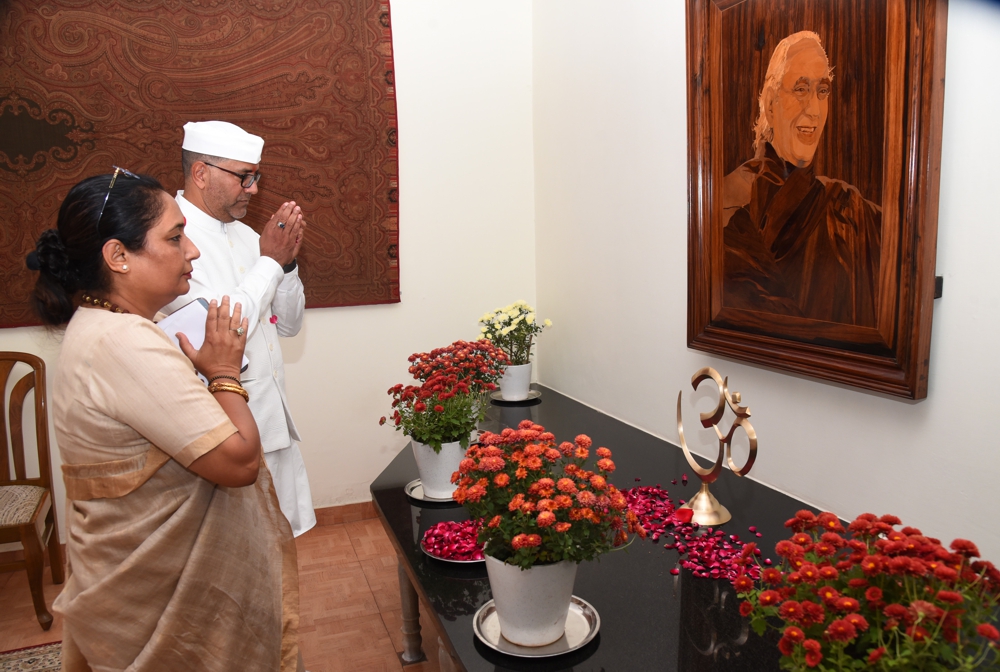
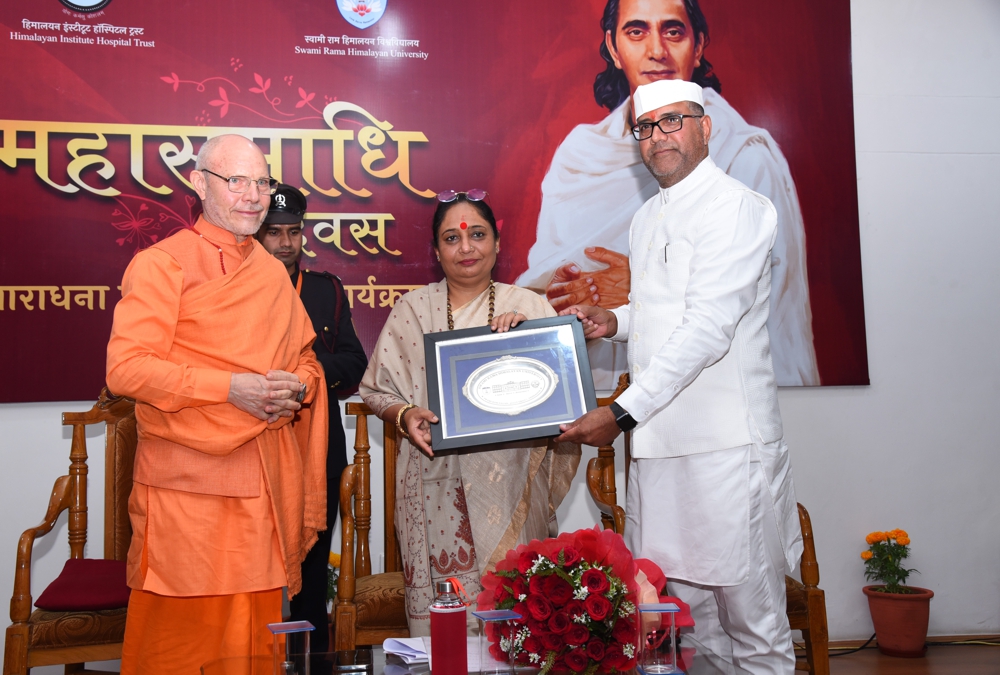
Speaker of the Uttarakhand Legislative Assembly Ritu Khanduri was the Chief Guest on the occasion. A large number of followers of Swami Rama from India and abroad, as well as invited dignitaries graced the occasion with their presence, apart from students and staff members.
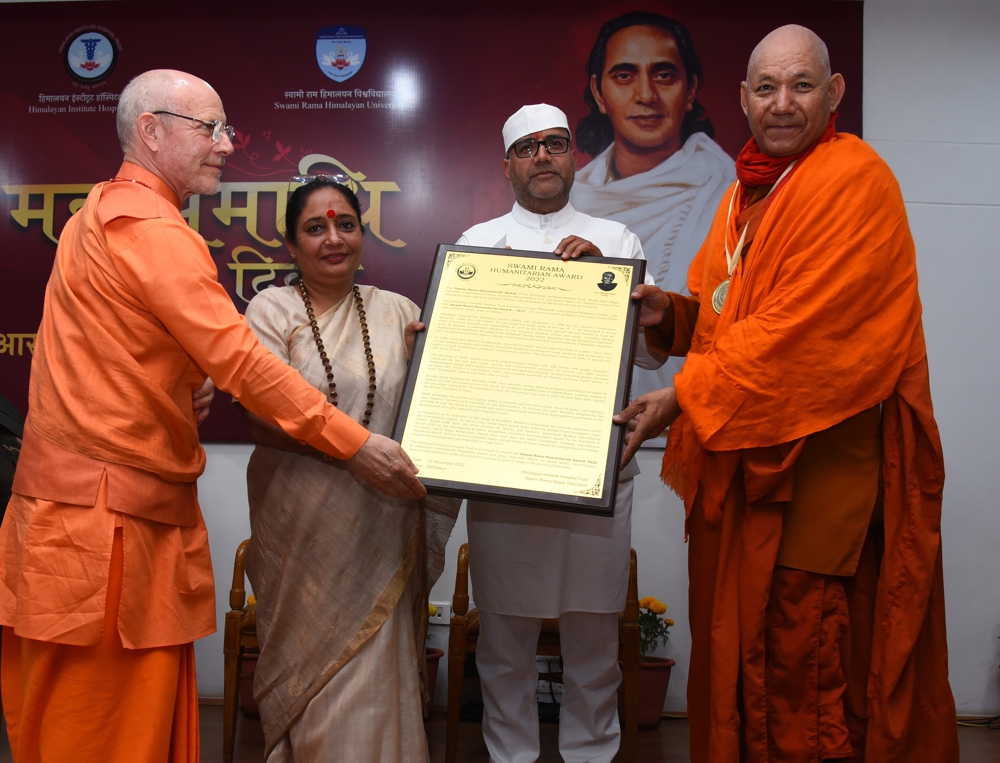
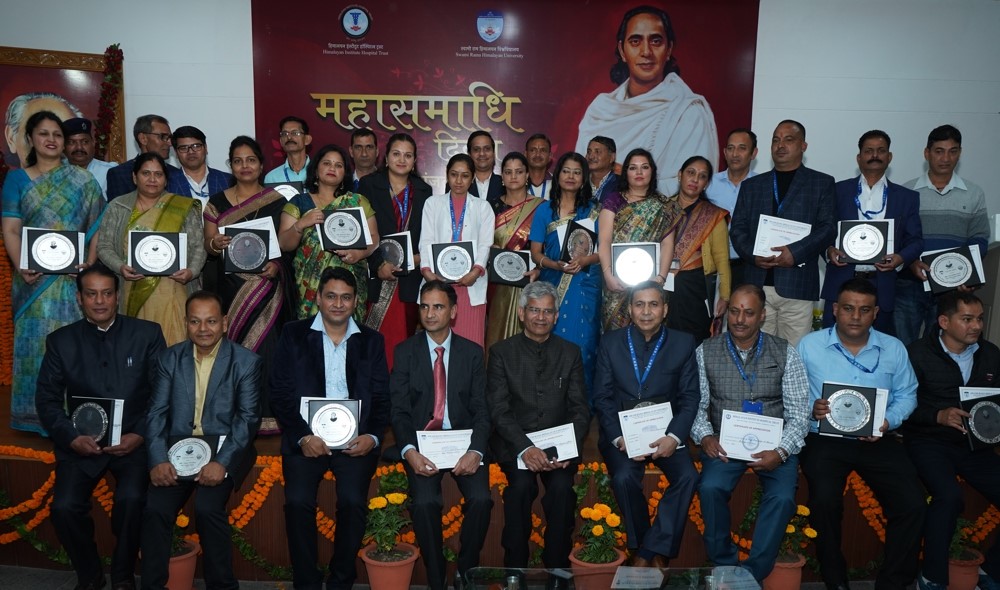
On the occasion, the ‘Swami Rama Humanitarian Award’ instituted in honour of the Founder President by the Himalayan Institute Hospital Trust, Swami Ram Nagar, was conferred upon Mahabodhi International Meditation Centre, Leh. Also, 31 employees of HIHT and SRHU were awarded for their dedication to service. Many of them have been employed with the organisation for over two decades.
Speaking on the occasion Speaker Khanduri reiterated that she was proud to be standing on the ground where education, health and spirituality have combined to make the earth a better place. She also released the annual calendar for the year 2023.

Dr. Vijay Dhasmana recalled the influence Swamiji had on his life as well as the lives of thousands. Dr. Dhasmana’s dedication to selfless service of mankind led his Guru, Swami Rama, to appoint him as the Treasurer of the Himalayan Institute Hospital Trust in 1994 and a Member of its Presidential Body in 1996. Dr. Dhasmana has been serving the vision and mission of his Guru tirelessly and whole-heartedly, taking the organisation to greater heights year after year. “We have truly believed and followed Gurudev’s teaching of ‘Love, Serve, Remember’ throughout and dedicated ourselves to the service of mankind. Gurudev’s commitment to healthcare, and promotion of medical education and research, has been an integral part of his vision for his motherland, Uttarakhand,” he reiterated. He outlined the work of the organisation over the years and its plans for the future. The programme was ably conducted by Dr Jyoti Diwedi.
Pro Vice Chancellor Dr. Vijendra Chauhan delivered the Vote of Thanks. Before that he invited all to partake in the Bhandara for Guruji’s Prasada.

Present on the occasion were Swami Rituwan Bharti, Dr. Mohan Swami, Vikram Singh, Dr. Prakash Keshvaya, Dr. Renu Dhasmana, Dr. Susheela Sharma, Dr. SL Jethani, Dr. Ashok Deorari, Dr. Rajendra Dhobhal and Dr. Mushtak Ahmad.
Founder Dr Swami Rama, was born in 1925 at Village Toli, Malla Badalpur, Pauri Garhwal Uttarakhand (erstwhile Uttar Pradesh) to an erudite Brahmin family. Swami Rama was raised from early childhood by a great yogi and saint of Bengal, who resided in the foothills of the Himalayas.
In his formative years, he practiced various disciplines of Yoga and Philosophy in the traditional monasteries of the Himalayas and studied closely with many spiritual adepts, including Mahatma Gandhi, Sri Aurobindo and Rabindranath Tagore. He also journeyed to Tibet to study with his grandmaster. Later, he received his higher education at Bangalore, Prayaga, Varanasi, and Oxford University, England. At the young age of 24 years he became Shankaracharya of Karvirpitham in Central India, succeeding Dr Kurtkoti to the highest spiritual position in India. During this term, he exercised tremendous impact on the spiritual customs of that time: he helped eliminate useless formalities and rituals, made it possible for all segments of society to worship in the temples, and encouraged the instruction of women in meditation.
Later, in 1952, he relinquished the dignity and prestige of this high office, to return to the Himalayas to intensify his meditative practices in the monasteries. After completing a forceful, 11-month meditation and pranayama practice in isolation in a sealed 6′ x 4′ cave, with only a single pinpoint of light, he emerged with the determination to serve humanity, particularly to bring the teachings of the East to the West. With the encouragement of his master, Swami Rama began his task by studying Western Philosophy and Psychology, and teaching Eastern Philosophy at many Western Universities. He worked as a medical consultant in London and assisted in para-psychological research in Moscow. He then returned to India, where he established a clinic and ashram (Sadhana Mandir Trust) in Rishikesh. In 1960, he completed his degree at the medical college in Darbhanga. Later, he went to Japan, where he established a major spiritual centre. At the behest of his master, he went to the United States in 1969 and established the Himalayan Institute of Yoga, Science and Philosophy.

Founder’s Message:

“In childhood, one learns through imitation and example. You don’t learn through books, mere words or through culture or philosophy but you learn by seeing what others do. When a mother and father are good examples for the child, then that child is very happy and secure and grows up without fears or selfishness. Modern society has not yet attained the height of a culture where you truly learn to give to your children. That is why it is still in a primitive state. Regrettably, these days, although human beings are growing, it is happening in a wild and selfish way.
Since your childhood you have been taught to see and examine things in the external world, but no one has ever taught you how to look within, see within and discover within. No one teaches you how to look within, to find something within, and to go to the ‘Source’ within. This subtle teaching is missing in your home life. This one important part of life is ignored by your educational systems at home, in the society and in the colleges and universities: know thyself, you need to understand yourself on all levels.
If children are trained systematically from the very beginning, they do not become absent-minded: being absent-minded means that you want to remember something, but at the same time, you don’t. The desire is there, the fire is there, but you are not really giving fuel to the fire: you don’t really evince full interest; the heart is missing!
I often find that in the schools and colleges, children are taught in the harshest and critical of ways. That is why they do not make much improvement in their lives: they become victims of the sole process of learning how to remember things. They do not learn the technique of how to forget things. They only know how to learn; they do not know how to unlearn. Because you do not know how to forget and unlearn, when you want to go to bed, to retire and relax your mind, you cannot really do this. You have not learned how to unlearn negative or disturbing things that you have learned. That creates serious problems all over the world, both in the West and the East, especially amongst younger generations. Many things are constantly going on in your mind; your mind is thinking and thinking and you cannot gain freedom from that process. ”

‘Swami Rama Humanitarian Award – 2022’

The Himalayan Institute Hospital Trust conferred the ‘Swami Rama Humanitarian Award – 2022’ upon Mahabodhi International Meditation Centre, Leh-Ladakh.
The award consists of Rs Five Lakhs, a Gold Medal and a Citation.
Mahabodhi International Meditation Centre (MIMC) was established in 1986 by Venerable Bhikkhu Sanghasena in Saboo-Dho, Leh-Ladakh. He had joined the Indian Army at the age of 17 and developed a strong sense of personal discipline and responsibility. In 1977, he felt the inner spiritual call and decided to leave the army to become a committed disciple of the renowned Buddhist scholar and monk, Venerable Acharya Buddharakkhita Mahathera, the Abbot of the Mahabodhi Society Vihara, Bangalore. Having received full ordination, Venerable Sanghasena undertook rigorous studies of the Dhamma and practiced various methods of Buddhist meditation.
In 1986, Venerable Bhikkhu Sanghasena, returned to Ladakh and founded the MIMC in Ladakh. Since then, he has worked tirelessly and selflessly to put the Buddha’s teachings of loving, kindness and compassion into action through multifarious charitable humanitarian services. The Devachan campus of MIMC is spread over 250 acres of land.

The activities of MIMC include providing underprivileged children safe shelter and quality education, healthcare for the sick and needy, literacy and empowerment programmes for women and other socially-disadvantaged groups and a caring environment for the aged and destitute.
Besides providing quality education for about 800 children in Leh-Ladakh, MIMC also supports hundreds of students pursuing higher studies in Delhi, Chandigarh, Jammu and other cities in India.
Besides these humanitarian activities, MIMC also conducts various spiritual programmes benefiting thousands of seekers of truth and peace around the world. An ambitious Buddha Park for World Peace is being created in the Devachan community. The foundation stone for this project was laid in 2017 by former President Ram Nath Kovind.
MIMC advocates the creation of a global family to promote spiritual and cultural values of peace, non-violence, inter-religious harmony and protection of the environment. To nurture this goal, Bhikku Sanghasena has travelled all over the world to join hands with other national and international organisations committed to the development of a safer, peaceful and integrated world.
In recognition of his dedication to the ideals of the MIMC, Bhikku Sanghasena has received numerous Indian and International awards. To name a few, World Peace Award-2004 from the Gandhi Peace Foundation, Rajiv Gandhi Award–2006 from the Chief Minister of Jammu and Kashmir, Sakyamuni Buddha International Award–2009 from the Ashwagosha Buddhist Foundation, President Commendation Award from the President of Sri Lanka, World Peace Ambassador Award–2014 from Save the World Foundation, Thailand, International Excellence Award–2020 by Nisha Foundation, Spain, and the Prime Minister’s Award for outstanding contribution towards the Development and Promotion of Yoga–2021.
The Himalayan Institute Hospital Trust is privileged to present the Swami Rama Humanitarian Award – 2022 to Mahabodhi International Meditation Centre and prays that their efforts for global peace, inter-religious harmony and protection of the environment continue to grow in scope in the service of humanity.

DSC_3609
3-1
DSC_3700
DSC_3540
   Admissions Form         

Admission Open For 2025

×
Nursing Advisor at Himalayan Institute Hospital Trust

Dr. Kathleen M. McKeehan

Dr. Kathleen M. McKeehan is a highly regarded American nursing leader and researcher who has dedicated decades to advancing nursing education and clinical practices at the Himalayan Institute Hospital Trust (HIHT) and Swami Rama Himalayan University (SRHU) in Dehradun, India. Serving as the Nursing Advisor, she has been instrumental in shaping the Himalayan College of Nursing into a center of excellence, emphasizing the integration of compassionate care with modern medical technology.

Dr. McKeehan’s academic background is extensive, including a Ph.D. in nursing from the Case Western Reserve University and post-doctoral research at Ohio State University. Before her long-term commitment to the Himalayan Institute, she held prestigious academic positions, such as the Dorothy Rider Pool Professorship at Allentown College. Her research expertise spans oncology nursing, continuing education strategies, and innovation diffusion in healthcare settings.

At HIHT, she is a central figure in tradition and mentorship, often leading the symbolic Lamp Lighting and Oath Ceremony for new nursing students. Her work focuses on fostering a vibrant research culture and ensuring that nursing curricula meet international standards while remaining rooted in the visionary humanitarian principles of the institute's founder, H.H. Dr. Swami Rama.

Former Director, LBSNAA

Dr. Sanjeev Chopra (IAS Retd.)

Dr. Sanjeev Chopra (IAS Retd.) is a distinguished former Indian Administrative Service officer (1985 batch, West Bengal cadre), historian, and author. He is most widely recognised for his tenure as the Director of the Lal Bahadur Shastri National Academy of Administration (LBSNAA) from 2019 until his retirement in March 2021. Throughout his 36-year bureaucratic career, he served in high-profile roles, including Additional Chief Secretary to the Government of West Bengal and Secretary of Industrial Development in Uttarakhand.

Since retiring, Dr. Chopra has emerged as a prominent literary figure and public intellectual. He is the Founder and Festival Director of Valley of Words, an international literature and arts festival based in Dehradun. An acclaimed author, his works include We, the People of the States of Bharat: The Making and Remaking of India’s Internal Boundaries (2022) and The Great Conciliator: Lal Bahadur Shastri and the Transformation of India (2025).

He holds a PhD in Management and has been a fellow at prestigious institutions like Cornell University and the World Bank. Currently, he continues to contribute as a columnist for ThePrint and serves as a Senior Fellow in Contemporary History at the Prime Ministers' Memorial and Library.

FRSB, FRSB

Prof. Graham Roy Ball

Prof. Graham Roy Ball, FRSB, is a distinguished expert in bioinformatics and computational systems biology. He currently serves as a Professor at Anglia Ruskin University (ARU), where he is the Director of the Medical Technology Research Centre. He also holds a significant role as the Chief Scientific Officer (CSO) of Intelligent OMICS Ltd, a company specializing in AI-driven biomedical discovery.

Prof. Ball's work focuses on applying Artificial Neural Networks (ANNs) and machine learning to solve complex biological problems. His research spans cancer systems biology, drug discovery, and the development of "molecular digital twins" for disease states. He is particularly noted for his work on the Nottingham Prognostic Index Plus (NPI+), a system that uses biomarkers to improve breast cancer patient stratification.

Before joining ARU, he was a Professor of Bioinformatics at Nottingham Trent University (NTU) for over two decades, where he led the John van Geest Cancer Research Centre’s biostatistics efforts. He has published more than 280 journal papers and holds multiple patents in the field of AI and omics data analysis. He is a Fellow of the Royal Society of Biology (FRSB) and serves on the editorial boards of prominent journals like Proteomics.

Prof. & Researcher at the Children’s Hospital of Philadelphia, University of Pennsylvania

Dr. Vinay Nadkarni

Dr. Vinay Nadkarni, MD, MS, is a world-renowned leader in pediatric critical care and resuscitation science. He serves as a Professor and Endowed Chair at the Children’s Hospital of Philadelphia (CHOP) and the University of Pennsylvania Perelman School of Medicine. He is the founding director of the CHOP Academy for Resuscitation of Children and the Center for Simulation, Advanced Education and Innovation.

Throughout his distinguished career, Dr. Nadkarni has served as President of the Society of Critical Care Medicine (2023-2024) and Co-Chair of the International Liaison Committee on Resuscitation (ILCOR). His research focuses on advancing CPR quality, sepsis management, and pediatric life support, contributing to over 850 peer-reviewed publications. He has also been a key figure in global health initiatives, including the ABC Stop the Bleed program in India and missions with Operation Smile.

Dr. Nadkarni has received numerous accolades, such as the American Heart Association’s Lifetime Achievement Award and the AAP Distinguished Career Award. He continues to mentor over 150 clinician-scientists while leading international efforts to strengthen the "chain of survival" for critically ill children worldwide.

Former Director General, UCOST

Mr. Sudhir Chandra Nautiyal

Mr. Sudhir Chandra Nautiyal is a highly accomplished civil servant and technocrat who served an illustrious 29-year tenure in the Industries Department of the Government of Uttarakhand. While he is often associated with leadership in state councils, he is most distinguished for his role as the Director of Industries. During his service, he was instrumental in positioning Uttarakhand as a leader in the MSME and Startup sectors.

A leather technology engineer from HBTU Kanpur with a Master’s in Economics, Nautiyal’s career spanned the private sector, public sector banking, and the Ministry of MSME. He is credited with leading the state to secure the first position in the North India Geographical Indication (GI) festival in 2022, successfully promoting indigenous products like Munsiyari Rajma and Ringal Craft.

Currently, he serves as a member of the Pravasi Uttarakhandi Cell in the Chief Minister’s Office, where he continues to facilitate investment and entrepreneurship for the state’s diaspora. His proactive approach has made him a respected figure in Indian industrial circles, recently earning him recognition at the Raj Bhavan for his lifelong contributions.

Former Fellow University of Liverpool, United Kingdom

Prof. Prabhu Narayan Mishra

Prof. Prabhu Narayan Mishra is a renowned Management Guru and academician with over 40 years of experience in teaching, research, and consulting. He is particularly recognized for his tenure as a Fellow in the Department of Economics & Accounting at the University of Liverpool, UK, where he served from 1996 to 1997. His international academic footprint also includes serving as a Senior Visiting Faculty at Tulane University, USA.

In India, Prof. Mishra has held several prestigious positions, including Director of the Institute of Management Studies (IMS) and officiating Vice Chancellor of Devi Ahilya University, Indore. He holds a Ph.D. in Mathematics from the University of Allahabad and is widely known for pioneering the study of Indian Ethos in Management, blending ancient Vedic wisdom with modern business theories.

A prolific scholar, he has supervised numerous doctoral students and authored several books and research papers. Prof. Mishra is also a dedicated philanthropist, serving as the Founder President of organizations like the Shri Krishna Foundation and Utkarsha, which focus on spiritual wisdom and community development. His multifaceted career is marked by prestigious awards, including the Commonwealth Academic Staff Fellowship and the United Nations Fellowship.

Ex Director, National JALMA

Prof. Kiran Katoch

Prof. Kiran Katoch is a highly respected academic researcher and medical scientist who served as the Director of the National JALMA Institute for Leprosy and Other Mycobacterial Diseases (NJILOMD) in Agra. With over four decades of experience, she has been a leading figure in the research and treatment of leprosy and tuberculosis in India. Her work is characterized by a unique focus on bridging clinical medicine with laboratory research to improve patient outcomes in mycobacterial infections.

A prolific scientist, Prof. Katoch has authored or co-authored over 150 research publications in prestigious national and international journals. Her seminal contributions include studies on the efficacy of multidrug therapy (MDT) for leprosy and the investigation of cardiovascular involvement in leprosy patients. For her outstanding research, she was honored with the Dr. C. G. S. Iyer Oration Award in 1989.

Beyond her administrative and research roles, she has served as the Editor of the Indian Journal of Leprosy and the President of the Tuberculosis Association of India (TAI). Even after her tenure as Director, she remains active as an ICMR Distinguished Scientist Chair, continuing to advocate for integrated health systems and innovative research to solve local health challenges.

Executive-in-Residence, S.P. Jain Institute of Management & Research

Mr. Prabhat Pani

Mr. Prabhat Pani is a distinguished corporate leader and academician with over 40 years of experience, currently serving as an Executive in Residence and Executive Director of the Centre for Impact in Sustainable Development at SPJIMR, Mumbai. An alumnus of IIM Ahmedabad, he began his career with the Tata Administrative Services (TAS) and has held numerous leadership roles across the Tata Group.

His corporate journey includes serving as the CEO of Ginger Hotels (Roots Corporation Ltd) and as the Executive Director of Taj SATS Air Catering. He also spent significant time in the telecom sector, holding senior roles at Tata Teleservices, Airtel, and BPL Cellular. Prior to his academic transition, he served as Head of Partnerships & Technology at Tata Trusts, where he led large-scale social impact initiatives.

At SPJIMR, Pani focuses on Sustainable Development and social sector interventions, bridging the gap between corporate efficiency and developmental needs. He is also a Senior Advisor at The Conference Board and continues to mentor social sector professionals. His work remains centered on building institutional capacity and leveraging technology for broad-based community impact.

Media Executive & Board Member, Times Group

Mr. A.P. Parigi

Mr. A.P. Parigi, is a veteran leader in the Indian media, entertainment, and telecommunications sectors with over 40 years of experience. He is most widely recognized as the Co-Founder of Radio Mirchi, where he served as the Managing Director and CEO of Entertainment Network India Ltd. (ENIL). Under his leadership, Radio Mirchi grew into India's largest private FM radio network, fundamentally changing the country's audio landscape.

Throughout his career, Parigi has held several high-profile roles, including Group CEO of Network18, CEO of BPL Mobile, and MD & CEO of Eros International Media. His strategic vision also spearheaded the Times Group’s entry into the Out-of-Home (OOH) media business. Beyond corporate leadership, he has served on the boards of major entities like Bennett Coleman & Co. Ltd. (The Times of India) and has been an advisor to global institutions such as the Saïd Business School at the University of Oxford.

An alumnus of the Delhi School of Economics and the Faculty of Management Studies (FMS), Delhi, Parigi was the first non-American to receive the Rensselaer Entrepreneur of the Year Award in 2009. Today, he continues to mentor next-generation leaders and advise organisations on growth, corporate governance, and digital transformation.

Former Director, IHBT

Dr. Sanjay Kumar

Dr. Sanjay Kumar, FNA, is a distinguished agricultural biotechnologist and the former Director of the CSIR-Institute of Himalayan Bioresource Technology (IHBT). Currently, he serves as the Chairman of the Agricultural Scientists Recruitment Board (ASRB), where he oversees the selection of top-tier scientific talent for India’s agricultural research sector. His leadership is defined by a commitment to converting high-end biotechnology into sustainable livelihoods for farmers in the Himalayan region.

During his tenure at CSIR-IHBT, Dr. Kumar achieved major milestones, including the historic introduction of Heeng (asafoetida) and monk fruit cultivation in India. His research spans plant molecular biology and genomics, specifically focusing on how Himalayan flora adapts to extreme environments. A fellow of all three major Indian science academies (FNA, FNASc, and FNAAS), he has published over 120 research papers. His work continues to play a vital role in strengthening India's bio-economy and ensuring long-term food security through innovation.

Pro-Chancellor, Perdana University, Malaysia

Dr. Mohan Swami 

Dr. Mohan Swami is a distinguished physician, entrepreneur, and educational visionary who currently serves as the Pro-Chancellor of Perdana University, Malaysia. A graduate of Mysore University, India, he began his medical career in 1978. He initially gained prominence in Sabah, where he established the largest private medical group practice, laying the foundation for his extensive career in healthcare management and corporate leadership.

Dr. Swami is widely recognized as the driving force behind the establishment of Perdana University in 2011. Under his leadership, the institution launched as a landmark public-private partnership, collaborating with world-class entities like the Johns Hopkins University School of Medicine. Beyond academia, he is the Executive Chairman of Chase Perdana Sdn Bhd and has held significant leadership roles in various multinational corporations across the healthcare, property, and hospitality sectors.

In addition to his professional achievements, Dr. Swami is a deeply spiritual individual. He serves as the President of the AHYMSIN (Association of Himalayan Yoga Meditation Societies International) and Chancellor of Swami Rama Himalayan University. For his immense contributions to education and the Malaysian economy, he was conferred the title of Tan Sri. He also serves as the Honorary Consul of Botswana in Malaysia, bridging international relations through diplomacy and philanthropy.

Mahamandleshwar Juna Akhara

Swami Avdheshanand

Swami Avdheshanand is one of India’s most influential spiritual leaders and the Acharya Mahamandaleshwar of the Juna Akhara, the largest order of Hindu monks. Born on November 24, 1962, in Bulandshahr, Uttar Pradesh, he displayed a profound spiritual inclination from childhood. Seeking higher truths, he renounced worldly life at a young age to practice intense meditation and austerity as a hermit in the Himalayas.

His teachings are rooted in Advaita Vedanta, focusing on self-realization, universal brotherhood, and the harmony of all religions. Beyond his role as a monastic leader, he is a globally respected philosopher who has addressed the United Nations and the World Economic Forum, advocating for global peace and environmental sustainability.

As the founder of Prabhu Premi Sangh, he oversees extensive social welfare projects, including healthcare initiatives, educational programs for the underprivileged, and environmental conservation efforts like the "Green Kumbh." A prolific author and orator, his discourses reach millions via television and digital platforms. Known for his serene demeanor and intellectual depth, Swami Ji continues to bridge the gap between ancient Vedic wisdom and modern global challenges, guiding seekers toward a life of purpose and spiritual clarity.