Published on: August 22, 2023
A Patent’s Success Story – Swami Rama Himalayan University granted valuable Patent
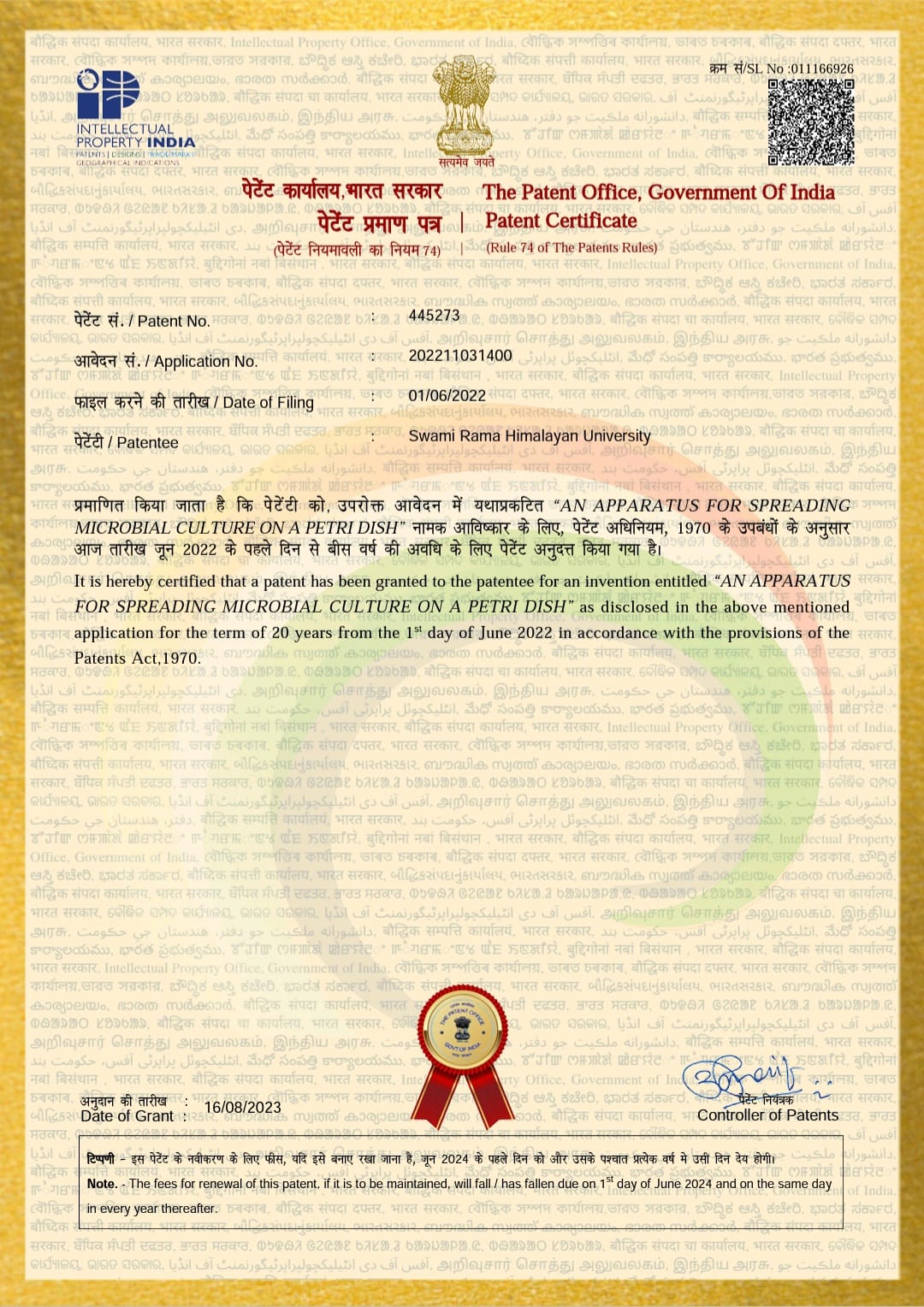
An apparatus for spreading microbial culture on a petri dish developed by the university has been granted patent by The Patent Office, GOI.
A new invention by the Department of Biosciences, Swami Rama Himalayan University has added another feather to its cap. This invention relates to a novel method and invention of an apparatus for spreading microbial cultures on a Petri dish.
The procedure has utility in evenly spreading the microbial culture on a soft microbiological growth medium in a Petri dish without damaging the agar surface.
Traditionally, skilled laboratory technicians using a hand tool known as spreader, made up of glass, plastic, metal, or any inert material, have performed the isolation of bacteria manually. Now this newly invented hand-tool or spreader typically includes a terminal loop to make multiple streaks.
Such microbial inoculation and streaking on Petri dishes are highly repetitious and, in many pathologies or diagnostic microbiology laboratories the process is usually conducted in very high volumes, such as in volumes as high as 1,000 to 15,000 plates per day. It is a tedious and laborious work, for which reason is prone to error and inaccuracies.
Another drawback of manual method of use of spreader by different persons can significantly affect the counting of microbes, which leads to variable results. Since different persons use diverse force and techniques to spread the microbial culture using a spreader on an agar Petri dish.
Due to the use of force and pressure, a significant reduction in microbial cell count has been reported. This reduction in microbial cell occurs during spread plating due to the physical impact of the spreader on the solid microbial media, and this causes injury to microbial cells. Even bacterial spores have been reported vulnerable to injury during spread-plating due to physical impact.
Therefore, to overcome the above-mentioned drawbacks, the present invention will greatly help. The procedure has utility in evenly and uniformly spreading the microbial culture on a soft microbiological growth medium in the Petri dishes without damaging the agar surface in a reproducible manner.
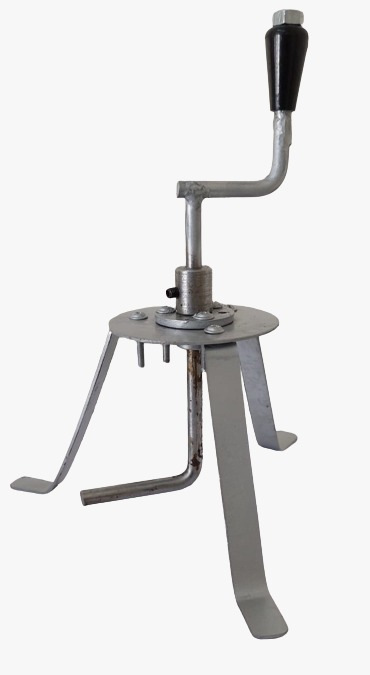
The apparatus is made up of a tripod stand having a central vertical rod, connected to a handle. Rotation of handle moves the central rod, which in turn rotates the horizontal smooth metallic rod. This horizontal rod moves softly on the agar medium surface in the Petri dish. This evenly and uniformly spreads the diluted microbial sample. Four to five rotations are sufficient to spread the microbial culture evenly. Spreading of microbial cultures with the help of this novel apparatus does not physically harm the microbial cells, thus leading to accurate and errorless results. The use of novel apparatus also saves tedious and laborious work of a technician.
Chancellor SHRU, Dr Vijay Dhasmana stated that, “At SRHU we nurture creative thinking to discover new vistas of inventions in the quest of knowledge. The recent patent awarded to us is a utility patent based on a novel microbiology method to isolate a single microorganism. In future we will endeavor to focus on more discoveries, which will open up new frontiers for human welfare. I congratulate the researchers for their commitment and recognize their accomplishment with pride.”
“Universities are increasingly being looked as leaders in scientific research, innovation and economic development. At SRHU working for new inventions with continue to be the driving force.” – Vice Chancellor, Dr Rajendra Dobhal
“The utility patent awarded to us is based on a novel method and an apparatus used for spreading microbial cultures on a Petri dish without damaging the agar surface and microorganisms, leading to precise and reproducible results.” Dr. Vivek Kumar, Associate Professor