Published on: August 26, 2022
Mammoth Water Conservation Effort launched at Swami Rama Himalayan University and Himalayan Hospital Campus, under Green Initiative
Swami Rama Himalayan University initiated a mammoth Green Initiative, under the leadership of Vice Chancellor Dr Vijay Dhasmana, for the conservation of water within the campus. Himalayan Institute Hospital Trust, a promoting society of SRHU has been working in Rain water harvesting since 1998.
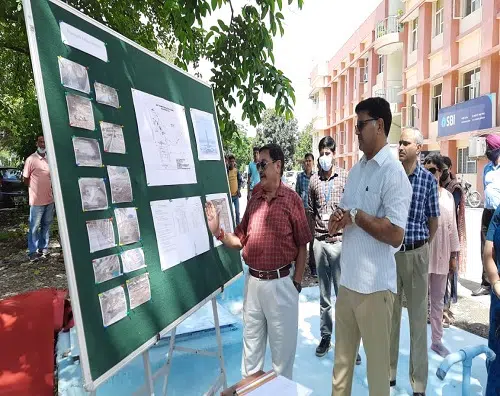
Technical expertise of ‘Uttaranchal Koop Man’, HP Uniyal was enlisted. He planned and managed the initiative technically. Under this initiative ‘Rain Water’ which is a valuable natural resource will be used for non-domestic purposes.
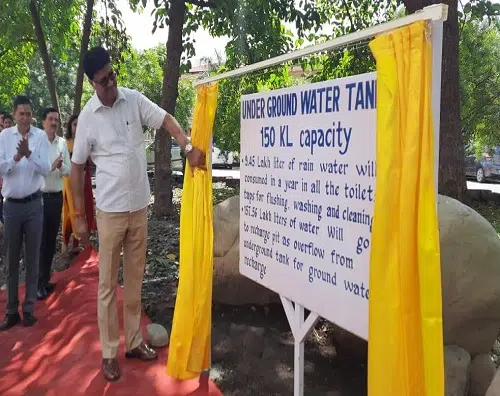
Dr Dhasmana formally launched the project today and dedicated it to India’s save water campaign. “Importantly the project will increase awareness of students about ‘scarcity of clean water’ and sensitize them on the importance of ‘conservation of water’, a precious natural resource,” he underlined. “This is our humble contribution aimed at reducing everyday water usage rate. We are all aware that water crisis in the world is getting critical day by day. When we realized that 80 percent of water requirement of the SRHU campus could be met with or replaced through rainwater harvesting we decided to go ahead with the project.”
After three months of meticulous planning and construction of the dream project, a whopping amount of about 2 crore litres of rainwater is being collected, stored and re- used for non potable purposes like toilet flushing, cleaning and ground aquifer recharge.
9000 sq mtrs of roof top areas of the Nursing College, Medical College and RDI Building at SRHU and Himalayan Hospital campus have been prepared to collect roof top rainwater. One lakh fifty thousand litres of water thus collected, is treated and filtered through a natural process with the help of ‘Uttaranchal Koop’ method, for which Uniyal was, conferred the National Urban Water 2008 Award. This water is collected in a 1.5 lac litre ‘Storage Tank’, which is completely underground.
In accordance with futuristic developmental plans a garden with a fountain will be developed and maintained on top of this tank.
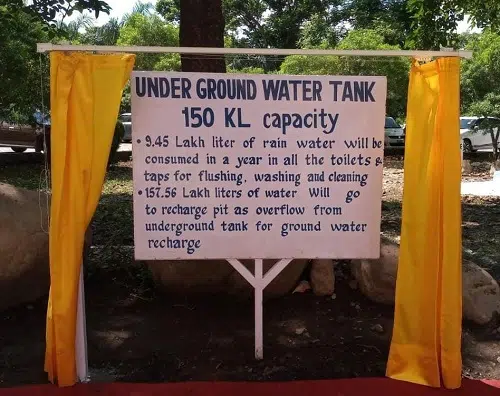
Ensuring continuity of water supply is crucial for the sustainable functioning of the system. “The water collected in 1.5 lac storage tank will be supplied to different buildings for flushing and cleaning and will be sufficient for 365 days. It will cater to 111 toilets and 138 taps. “We have cut off the normal supply of water, and instead supply 3000 litres per day of collected roof top rain water, which we calculated is the daily need,” Uniyal explained.
To arrive at this figure 19 years of rainfall data was studied, average monthly rainfall calculated, and inlet and outlet water supply quantity calculated. 9 lakh 45000 litres of roof top rainwater will be used for daily flushing and cleaning needs. And importantly 1 crore 57 lakh litre of water will be utilized for ground water recharging.
The capacity of our underground storage tank is 1.5-lakh litres. It would be sufficient to supply 3000 litres of water to the 111 toilets and 138 taps for a period of 365 days, Dr Dhasmana proudly revealed.