
Report of special invited lecture by Dr Subrata Sinha

Published on: November 22, 2025

Report of special invited lecture by Dr Subrata Sinha

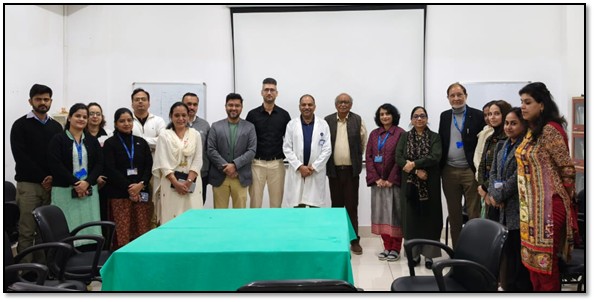
The School of Biosciences, Swami Rama Himalayan University, Dehradun hosted a special invited lecture on 22nd November 2025, delivered by Prof. Subrata Sinha, Former-President AIIMS Patna, Former Professor and Head, Department of Biochemistry, AIIMS, New Delhi, a distinguished neuroscientist and expert in neurogenetics and biochemistry. The lecture, titled “From Behaviour to Genes in Dyslexia, through a Window of Epigenetics”, explored the complex neurobiological foundations of developmental dyslexia, highlighting the interplay between cognitive behaviour, genetic predispositions, and epigenetic regulatory mechanisms. The session was attended by faculty members, researchers, and students from School of Biosciences, Yoga Sciences.

Dr Sinha began by contextualizing dyslexia as a neurodevelopmental learning disorder that primarily affects reading, phonological processing, and language acquisition. He emphasized that dyslexia is not a result of intellectual impairment, but rather arises from subtle differences in brain structure and function. Dr Sinha presented an overview of major genes implicated in dyslexia, such as: DCDC2, KIAA0319, ROBO1, DYX1C1. These genes are involved in neuronal migration, axon guidance, and cortical organization, processes crucial for language network development. He highlighted those dyslexia is polygenic, with multiple genes contributing modestly to overall risk. He explained how variants in these genes may influence neuronal migration, axonal growth, and synaptic plasticity during brain development. Genome-wide association studies (GWAS) and linkage analyses were presented as major tools in delineating the genetic landscape. One of the most insightful segments of the lecture was Dr Sinha’s discussion on epigenetics—heritable, reversible biochemical modifications that regulate gene expression without altering DNA sequence and role of lnc RNA.

The lecture by Prof. Sinha provided a comprehensive and insightful overview of dyslexia, spanning the spectrum from behavioural presentation to underlying genetic and epigenetic mechanisms. It offered participants a deeper understanding of how modern biology is reshaping our approach to learning disorders.

The School of Biosciences expressed gratitude to Dr Sinha for his illuminating talk and for inspiring young researchers to explore this interdisciplinary frontier.

Prof Sinha also shared the research done by his group with the faculty of Neurosciences, HIMS, SRHU. It emerged that a few collaborative projects could be undertaken between NBRC and SRHU including student’s exchange activities for furtherance of clinical oriented researchable problems as also exposure to newer techniques.
Picture2
   Admissions Form         

Admission Open For 2025

×
International Endowed Chair Professor

Prof Rakesh Kumar

Prof Rakesh Kumar is the Founder and President of the Breast Cancer in Young Women Foundation (USA), dedicated to vaddressing the distinct issues affecting young women with breast cancer. He also serves as the International Endowed Chair Professor at the Cancer Research Institute of the Himalayan Institute of Medical Sciences. Additionally, he holds adjunct professorships at Rutgers New Jersey Medical School and Virginia Commonwealth University.

Dr Kumar earned his Ph.D. from the All India Institute of Medical Sciences in 1984 and began his research career at Memorial Sloan Kettering Cancer Center in January 1986. From 1988 to 2017, he held various academic and leadership positions —including faculty member, tenured professor, distinguished professor, endowed chair, department chair, and research leader—at esteemed institutions such as Memorial Sloan Kettering Cancer Center in New York and the University of Texas MD Anderson Cancer Center in Houston. From 2017 to 2022, he served as the National Chair for Cancer Research for the Government of India and as a distinguished professor, continuing his innovative work in breast cancer research.

With nearly 40 years of research and professional experience, Dr. Kumar has made conceptual contributions to the field of cancer research (h-index 108, citations >50,000). He has authored over 325 peer-reviewed publications, edited or co-edited nine books, and delivered 290 invited lectures worldwide. His work has been featured on the covers of 18 major cancer journals and has been highlighted in institutional research reports of the MD Anderson Cancer Center.

A passionate educator and mentor, Dr. Kumar has guided 67 trainees throughout his career. He serves on the editorial boards of multiple leading cancer journals and has served on the editorial boards of 21 top cancer journals. His global reputation is further demonstrated by his participation in about 100 peer-review panels for cancer research funding in the US and internationally over the past 28 years.

Dr. Kumar's innovative research has earned him numerous prestigious honors, including the Hinkle Society Faculty Award at Penn State University (1994), the Dalla/Fort Worth Living Legend Faculty Achievement Award in Basic Sciences (2004), the Ranbaxy Research Award (2006), and the Lifetime Achievement Award from the American Association of Indian Scientists in Cancer Research (2013), among others. Dr. Kumar's pioneering research continues to have a profound influence on the fields of oncology and breast cancer, opening up new opportunities for biomedical scientists and trainees worldwide.