This Policy shall be called “Policy for Condemnation and/or Disposal of Movable Assets” of the University.
This Policy shall come into force from the date of approval of the Board of Governors of the University.
Objective of the Policy
To develop a mechanism, incorporate efficient & economic practices for Condemnation & adherence to relevant laws, regulations, safety and environmental considerations while disposal.
To ensure proper documentation and accounting of Condemned Assets and the financial implications of their disposal.
To establish cost effective structure for life cycle of goods and optimum resource utilization and reutilization.
Definitions
“Act” means Uttarakhand Private Universities Act, 2023 (Act no. 2 of 2024).
“AMC” means Annual Maintenance Contract.
“Assets” means a Tangible or intangible asset of the University. Tangible Assets include machinery, equipment, furniture/ fixtures, IT Hardware etc. while intangible assets include Software, Licenses etc.
“CMC” means Comprehensive Maintenance Contract.
“Authority” means an authority of the University as defined in the Act or Statutes.
“Committee” means duly Constituted Committee.
“Condemnation” means the process of discarding the institutional movable assets which are unfit for use as per the decision of the Institute.
“Constituent Academic Unit” means a College/School/Institution maintained & managed by the University.
“Department” means the department of the University or its constituent academic unit.
“Disposal” means the process of liquidating the assets which are unfit for use according to its value by appropriate authority after the condemnation.
“EID” means Equipment Identification Data.
“EMH” means Equipment Maintenance History.
“E-waste” means electronic waste (or e-waste). Also commonly known as Waste Electrical and Electronic Equipment (WEEE) or end-of-life (EOL) Electronics.
“Officer” means officers of the University.
“Ordinances” means ordinances of the University.
“Sponsoring Body” means Himalayan Institute Hospital Trust.
“Regulations” mean the Regulations of the University.
“Statutes” means the statutes of the University.
“University” means Swami Rama Himalayan University.
Scope of Policy
This policy outlines the procedure for write-off, condemnation and disposal of Assets including capital assets, inventory and stocks purchased by the University from its funds or purchases in the Project. This policy shall also be applicable for Assets owned by the Sponsoring Body and used by the University.
An Asset may be declared obsolete or unserviceable if the same is of no use to the University or when the Assets are beyond economical repair. An Asset may be rendered obsolete or unserviceable in the process of upgrading or replacing University’s any Asset no longer in functional use due to any reason. Under such circumstances the Asset be disposed of either under buy-back scheme or otherwise in the best interest of the University with approval of the competent authority.
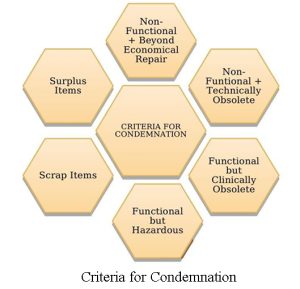
Every Asset irrespective of its cost has a specified serviceability life or period. After that, it becomes unserviceable even though all measures are taken to get the Asset functional. Un-serviceability may be due to any one of the following reasons:
Wear & tear due to prolonged use.
Completion of Prescribed life. The Asset may be considered for condemnation when parts & service support is no longer available. A certificate from the manufacturer to be obtained to this effect.
Hazardous Assets: Further use of Asset may be harmful to health of human-beings.
Obsolete Assets in use but being replaced due to purchase of latest model.
Damage due to unforeseen situations such as Fire, natural calamity, accident etc
Beyond economical Repair. A certificate of beyond repair to be obtained from manufacturer or authorised service agency to be obtained.
Miscellaneous:
Mishandling or mischief on the part of the employee/end user, then the Assets need to be considered for Condemnation & the responsibility of the same be fixed.
Regulatory compliance.
Any Asset purchased/used by University and purchases in projects shall be condemned/disposed-off with prior permission of the Sponsoring Body and as per provision of the Statues, Ordinances & Regulations as specified under the provisions of Section 10(v) of ‘The Uttarakhand Private University Act, 2023’ (Act No. 02 of 2024).
Condemnation CriteriaThe condemnation process typically involves inspection, evaluation, and documentation of the reasons for condemnation. Depending on the situation and regulations, condemned assets may need to be decommissioned, repaired, replaced, or disposed of in accordance with established procedures to ensure safety, compliance & efficiency.
Condemnation Process
For making recommendations for Condemnation of Assets a Condemnation Committee comprising of minimum 05 (five) members shall be constituted by the Board of Management of the University. There can be various condemnation committees for different areas within SRHU viz. Hospital, Academic Units etc.
The Chairperson of the Committee shall not be below the rank of Professor while the Manager, Inventory Management shall be the Member-Secretary of the committee. Representatives from various departments viz. Biomedical/IT/Electrical/Mechanical etc. shall be included in the committee for their expert opinion.
The Condemnation Committees shall meet as and when required. The Condemnation Committee shall send its recommendation to the Registrar of the University who shall take necessary steps to get the recommendation approved by the appropriate authority of the University and the Sponsoring Body.
If the Condemnation Committee is of the opinion that the asset has been damaged, mishandled, misused or being lost, the committee shall record the reasons in the recommendation report for appropriate action by the competent authority.
Condemnation & Disposal Procedure
Head of Department of Constituent Academic Unit shall prepare a condemnation note and furnish the requisite information in prescribed Proforma for condemnation as provided in Annexure A toAnnexure E on page no.7-12 for Assets of both Medical & Non-Medical nature containing therein Asset Identification Data (EID) with the descriptions, like name, model, serial number of assets, register no., name of the manufacturer, purchase date, purchase price, reason for condemnation, Asset Maintenance History (EMH) citing details like guarantee period of the asset, insurance, if any, AMC/CMC details, measures taken to get the asset functional, technical report of the engineers and also whether the asset is non-functional due to negligence, overuse, fraud or mischief on the part of the employee and additional information if any.
In other cases, where the life period is not over or no life period has been prescribed or stipulated, the reason for declaring the Assets unserviceable should be clearly recorded such as may be normal wear and tear, excessive use in public interest, accidental fire, flood & other natural causes, damage due to insect, rats etc. However, the condition of the assets should still be thoroughly examined to see whether the same could be put to further use.
The proposal of the condemnation of the Assets under consideration preferably in the prescribed form duly filled & signed by Head of Department shall be submitted to the Chairperson of the concerned Condemnation Committee who will then organize a meeting of the Condemnation Committee.
The Condemnation Committee upon evaluation of the furnished information pertaining to the Assets to be declared obsolete/unserviceable/unusable on the basis of furnished information in Annexure A to Annexure E, shall declare the assets as obsolete, or unserviceable or unusable and order their disposal in the submitted prescribed Form. Committee shall physically examine the asset required condemnation
After approval of the competent authority of the University, the Registrar shall forward a copy of the approval to the Material Management Department and Finance Department.
The Material Management Department shall get the condemned assets removed from the concerned Constituent Academic Unit(s) or the department to the place earmarked for their temporary storage ideally within three days or at the earliest from the date of receipt of the copy of the condemnation approval. The Material Management Department shall ensure that the condemned assets bear a condemnation tag for identification purposes.
E- Waste (Management & Handling) Rules, 2011 were notified in 2011 and had come into force since 1st May, 2012. Government of India in supersession of E-Waste (Management and Handling) Rules, 2011 has notified the E-Waste (Management) Rules, 2016 vide G.S.R. 338(E) effective from 01-10-2016. Two categories of electrical and electronic equipment namely (i) IT and Telecommunication Equipment and (ii.) Consumer Electricals and Electronics such as TVs, Washing Machines, Refrigerators Air Conditioners including fluorescent and other mercury containing lamps are covered under these Rules.
Towards the compliance of Rules & Guidelines as specified on para 7.7 above and disposal of the assets of nature Electrical, Electronics & Metal waste, an E- Waste Store has been set-up under Materials Management Department vide Circular No. SRHU/ Reg/Cir/ 2022-46 dated 29.11.2022 to store such E-waste material for its eventual disposal through authorized E- waste vendors.
Scrap of Consumable Assets
During the day to day functioning either in the University and/or in any of its Constituent Academic Unit or Department, huge quantity of consumable assets is used. Subsequent to use, scrap remain in various forms, i.e. iron scrap, plastic scrap, brass scrap, aluminium scrap, empty containers, broken glasses, packing material, empty glass/plastic bottles, paper scrap, wooden scrap etc. The scrap, as and when created, should be referred to the Material Management Department who shall ensure dumping of the scrap in a designated place from where it can be disposed-off by auction or through entering into a contract.
The Scrap usually comprising of Electrical and Electronic Assets, Hazardous Waste, Batteries etc. should be sold keeping in view the exact guidelines of Environment (Protection) Act, 1986 & subsequent amendments under E-Waste (Management) Second Amendment Rules, 2023. Prospective bidders of such lots of hazardous waste/scrap batteries/e-waste should have requisite valid licence/authorisation on the date of e-Auction and on the date of delivery, as recycler/pre-processor agency.
The scrap assets are disposed of to the vendors as per approved Rate (Rs) considering the actual weight of these assets or as per pre agreed upon terms.
Disposal of Condemned/Scrap Assets
There shall be a Disposal Committee for disposing of the Condemned and Scrap Assets comprising of a member nominated by the President as the Chairperson, the Finance Officer or his representative, and the Manager, Inventory Management as the Member-Secretary.
The Disposal Committee either through a tender or open auction or by any other means as deemed fit shall dispose of the condemned/scrap Assets.
When disposing of the condemned Assets, the Disposal Committee shall obtain the scrap value, together with appropriate documentation to indicate that the assets have been disposed of as scrap.
Copies of the invoice(s) of the condemned/ Scrap should be retained by Material Management Department and Finance Department for a minimum period as required by law.
Under no circumstances, condemned assets should remain in use once the condemnation proceedings have been finalized.
The Finance Department and Material Management Department shall ensure that condemnation and disposal of such assets are properly recorded in the University’s financial records and periodic statement of account.
Precautions for Disposal
When disposing of any assets other than by destruction or scrapping, the following stringent precautions should be taken:
Assets must be checked to ensure they are safe at the time of sale or disposal.
A signed receipt must be obtained from the recipient (the owner/in-charge) accepting responsibility for the use only in accordance with the manufacturers’ instructions and for ensuring further regular checking and maintenance.
The department using the assets must inform the Condemnation Committee of any known hazardous substances contained in the assets. These assets are classified as Special Waste and as such must be dealt with in accordance with the Environmental Protection Act of 1986.
Hazardous assets should be handled with utmost care and must be dealt with in accordance with the provisions of Environment Protection Act 1986 so that no claim is established against the University in any court of law.
Specific precaution for disposal of “Medical Devices” should be taken. Similarly, assets relating to lab & I.T, stringent caution must be taken when disposing of obsolete equipment and ensure that the disposal will not lead to prosecution or payment of damages.
Written Undertakings
The University should obtain a written undertaking from the new owner, if any, at the time of disposal. The recipient must give, in writing, that they are aware of latent or inherent risks. An undertaking along the following lines may be appropriate:”The recipient accepts responsibility for having the asset checked before use and thereafter maintained appropriately to ensure its continued safe and effective use and for following any instructions, advice or warnings issued by the manufacturer or the institution which is allowing the recipient to use it”.
This does not apply to the sale or donation of Medical Equipment or other Equipment which are strictly forbidden.
Waste Management Aspects
When disposing of scrap and unwanted assets, it must be understood that Health Providers have specific responsibilities under the Environmental Protection Act of 1986 in particular the Waste Management of hospital and IT products.
The safe disposal besides the legal precautions will usually include:
Removal of lead acid, Nickel Cadmium or other alkaline batteries for separate disposal.
Evacuation of Cathode ray tubes to prevent the risk of explosion (Usually by breaking off the nipple at the back of the tube).
Removal of in-line fuses.
Cleaning and decontamination.
Removal of all means to power up the device. (i.e. on hard wired devices the mains cable should be cut-off).
Removal of all hoses able to pressurize a device (if driven by gases).
Once these precautions have been taken, the asset may be thrown in the skip to be taken to the local landfill site or incinerated where appropriate.
The University reserves the right to interpret, alter, amend, modify, cancel or withdraw provisions without notice.
Nursing Advisor at Himalayan Institute Hospital Trust
Dr. Kathleen M. McKeehan
Dr. Kathleen M. McKeehan is a highly regarded American nursing leader and researcher who has dedicated decades to advancing nursing education and clinical practices at the Himalayan Institute Hospital Trust (HIHT) and Swami Rama Himalayan University (SRHU) in Dehradun, India. Serving as the Nursing Advisor, she has been instrumental in shaping the Himalayan College of Nursing into a center of excellence, emphasizing the integration of compassionate care with modern medical technology.
Dr. McKeehan’s academic background is extensive, including a Ph.D. in nursing from the Case Western Reserve University and post-doctoral research at Ohio State University. Before her long-term commitment to the Himalayan Institute, she held prestigious academic positions, such as the Dorothy Rider Pool Professorship at Allentown College. Her research expertise spans oncology nursing, continuing education strategies, and innovation diffusion in healthcare settings.
At HIHT, she is a central figure in tradition and mentorship, often leading the symbolic Lamp Lighting and Oath Ceremony for new nursing students. Her work focuses on fostering a vibrant research culture and ensuring that nursing curricula meet international standards while remaining rooted in the visionary humanitarian principles of the institute's founder, H.H. Dr. Swami Rama.
Former Director, LBSNAA
Dr. Sanjeev Chopra (IAS Retd.)
Dr. Sanjeev Chopra (IAS Retd.) is a distinguished former Indian Administrative Service officer (1985 batch, West Bengal cadre), historian, and author. He is most widely recognised for his tenure as the Director of the Lal Bahadur Shastri National Academy of Administration (LBSNAA) from 2019 until his retirement in March 2021. Throughout his 36-year bureaucratic career, he served in high-profile roles, including Additional Chief Secretary to the Government of West Bengal and Secretary of Industrial Development in Uttarakhand.
Since retiring, Dr. Chopra has emerged as a prominent literary figure and public intellectual. He is the Founder and Festival Director of Valley of Words, an international literature and arts festival based in Dehradun. An acclaimed author, his works include We, the People of the States of Bharat: The Making and Remaking of India’s Internal Boundaries (2022) and The Great Conciliator: Lal Bahadur Shastri and the Transformation of India (2025).
He holds a PhD in Management and has been a fellow at prestigious institutions like Cornell University and the World Bank. Currently, he continues to contribute as a columnist for ThePrint and serves as a Senior Fellow in Contemporary History at the Prime Ministers' Memorial and Library.
FRSB, FRSB
Prof. Graham Roy Ball
Prof. Graham Roy Ball, FRSB, is a distinguished expert in bioinformatics and computational systems biology. He currently serves as a Professor at Anglia Ruskin University (ARU), where he is the Director of the Medical Technology Research Centre. He also holds a significant role as the Chief Scientific Officer (CSO) of Intelligent OMICS Ltd, a company specializing in AI-driven biomedical discovery.
Prof. Ball's work focuses on applying Artificial Neural Networks (ANNs) and machine learning to solve complex biological problems. His research spans cancer systems biology, drug discovery, and the development of "molecular digital twins" for disease states. He is particularly noted for his work on the Nottingham Prognostic Index Plus (NPI+), a system that uses biomarkers to improve breast cancer patient stratification.
Before joining ARU, he was a Professor of Bioinformatics at Nottingham Trent University (NTU) for over two decades, where he led the John van Geest Cancer Research Centre’s biostatistics efforts. He has published more than 280 journal papers and holds multiple patents in the field of AI and omics data analysis. He is a Fellow of the Royal Society of Biology (FRSB) and serves on the editorial boards of prominent journals like Proteomics.
Prof. & Researcher at the Children’s Hospital of Philadelphia, University of Pennsylvania
Dr. Vinay Nadkarni
Dr. Vinay Nadkarni, MD, MS, is a world-renowned leader in pediatric critical care and resuscitation science. He serves as a Professor and Endowed Chair at the Children’s Hospital of Philadelphia (CHOP) and the University of Pennsylvania Perelman School of Medicine. He is the founding director of the CHOP Academy for Resuscitation of Children and the Center for Simulation, Advanced Education and Innovation.
Throughout his distinguished career, Dr. Nadkarni has served as President of the Society of Critical Care Medicine (2023-2024) and Co-Chair of the International Liaison Committee on Resuscitation (ILCOR). His research focuses on advancing CPR quality, sepsis management, and pediatric life support, contributing to over 850 peer-reviewed publications. He has also been a key figure in global health initiatives, including the ABC Stop the Bleed program in India and missions with Operation Smile.
Dr. Nadkarni has received numerous accolades, such as the American Heart Association’s Lifetime Achievement Award and the AAP Distinguished Career Award. He continues to mentor over 150 clinician-scientists while leading international efforts to strengthen the "chain of survival" for critically ill children worldwide.
Former Director General, UCOST
Mr. Sudhir Chandra Nautiyal
Mr. Sudhir Chandra Nautiyal is a highly accomplished civil servant and technocrat who served an illustrious 29-year tenure in the Industries Department of the Government of Uttarakhand. While he is often associated with leadership in state councils, he is most distinguished for his role as the Director of Industries. During his service, he was instrumental in positioning Uttarakhand as a leader in the MSME and Startup sectors.
A leather technology engineer from HBTU Kanpur with a Master’s in Economics, Nautiyal’s career spanned the private sector, public sector banking, and the Ministry of MSME. He is credited with leading the state to secure the first position in the North India Geographical Indication (GI) festival in 2022, successfully promoting indigenous products like Munsiyari Rajma and Ringal Craft.
Currently, he serves as a member of the Pravasi Uttarakhandi Cell in the Chief Minister’s Office, where he continues to facilitate investment and entrepreneurship for the state’s diaspora. His proactive approach has made him a respected figure in Indian industrial circles, recently earning him recognition at the Raj Bhavan for his lifelong contributions.
Former Fellow University of Liverpool, United Kingdom
Prof. Prabhu Narayan Mishra
Prof. Prabhu Narayan Mishra is a renowned Management Guru and academician with over 40 years of experience in teaching, research, and consulting. He is particularly recognized for his tenure as a Fellow in the Department of Economics & Accounting at the University of Liverpool, UK, where he served from 1996 to 1997. His international academic footprint also includes serving as a Senior Visiting Faculty at Tulane University, USA.
In India, Prof. Mishra has held several prestigious positions, including Director of the Institute of Management Studies (IMS) and officiating Vice Chancellor of Devi Ahilya University, Indore. He holds a Ph.D. in Mathematics from the University of Allahabad and is widely known for pioneering the study of Indian Ethos in Management, blending ancient Vedic wisdom with modern business theories.
A prolific scholar, he has supervised numerous doctoral students and authored several books and research papers. Prof. Mishra is also a dedicated philanthropist, serving as the Founder President of organizations like the Shri Krishna Foundation and Utkarsha, which focus on spiritual wisdom and community development. His multifaceted career is marked by prestigious awards, including the Commonwealth Academic Staff Fellowship and the United Nations Fellowship.
Ex Director, National JALMA
Prof. Kiran Katoch
Prof. Kiran Katoch is a highly respected academic researcher and medical scientist who served as the Director of the National JALMA Institute for Leprosy and Other Mycobacterial Diseases (NJILOMD) in Agra. With over four decades of experience, she has been a leading figure in the research and treatment of leprosy and tuberculosis in India. Her work is characterized by a unique focus on bridging clinical medicine with laboratory research to improve patient outcomes in mycobacterial infections.
A prolific scientist, Prof. Katoch has authored or co-authored over 150 research publications in prestigious national and international journals. Her seminal contributions include studies on the efficacy of multidrug therapy (MDT) for leprosy and the investigation of cardiovascular involvement in leprosy patients. For her outstanding research, she was honored with the Dr. C. G. S. Iyer Oration Award in 1989.
Beyond her administrative and research roles, she has served as the Editor of the Indian Journal of Leprosy and the President of the Tuberculosis Association of India (TAI). Even after her tenure as Director, she remains active as an ICMR Distinguished Scientist Chair, continuing to advocate for integrated health systems and innovative research to solve local health challenges.
Executive-in-Residence, S.P. Jain Institute of Management & Research
Mr. Prabhat Pani
Mr. Prabhat Pani is a distinguished corporate leader and academician with over 40 years of experience, currently serving as an Executive in Residence and Executive Director of the Centre for Impact in Sustainable Development at SPJIMR, Mumbai. An alumnus of IIM Ahmedabad, he began his career with the Tata Administrative Services (TAS) and has held numerous leadership roles across the Tata Group.
His corporate journey includes serving as the CEO of Ginger Hotels (Roots Corporation Ltd) and as the Executive Director of Taj SATS Air Catering. He also spent significant time in the telecom sector, holding senior roles at Tata Teleservices, Airtel, and BPL Cellular. Prior to his academic transition, he served as Head of Partnerships & Technology at Tata Trusts, where he led large-scale social impact initiatives.
At SPJIMR, Pani focuses on Sustainable Development and social sector interventions, bridging the gap between corporate efficiency and developmental needs. He is also a Senior Advisor at The Conference Board and continues to mentor social sector professionals. His work remains centered on building institutional capacity and leveraging technology for broad-based community impact.
Media Executive & Board Member, Times Group
Mr. A.P. Parigi
Mr. A.P. Parigi, is a veteran leader in the Indian media, entertainment, and telecommunications sectors with over 40 years of experience. He is most widely recognized as the Co-Founder of Radio Mirchi, where he served as the Managing Director and CEO of Entertainment Network India Ltd. (ENIL). Under his leadership, Radio Mirchi grew into India's largest private FM radio network, fundamentally changing the country's audio landscape.
Throughout his career, Parigi has held several high-profile roles, including Group CEO of Network18, CEO of BPL Mobile, and MD & CEO of Eros International Media. His strategic vision also spearheaded the Times Group’s entry into the Out-of-Home (OOH) media business. Beyond corporate leadership, he has served on the boards of major entities like Bennett Coleman & Co. Ltd. (The Times of India) and has been an advisor to global institutions such as the Saïd Business School at the University of Oxford.
An alumnus of the Delhi School of Economics and the Faculty of Management Studies (FMS), Delhi, Parigi was the first non-American to receive the Rensselaer Entrepreneur of the Year Award in 2009. Today, he continues to mentor next-generation leaders and advise organisations on growth, corporate governance, and digital transformation.
Former Director, IHBT
Dr. Sanjay Kumar
Dr. Sanjay Kumar, FNA, is a distinguished agricultural biotechnologist and the former Director of the CSIR-Institute of Himalayan Bioresource Technology (IHBT). Currently, he serves as the Chairman of the Agricultural Scientists Recruitment Board (ASRB), where he oversees the selection of top-tier scientific talent for India’s agricultural research sector. His leadership is defined by a commitment to converting high-end biotechnology into sustainable livelihoods for farmers in the Himalayan region.
During his tenure at CSIR-IHBT, Dr. Kumar achieved major milestones, including the historic introduction of Heeng (asafoetida) and monk fruit cultivation in India. His research spans plant molecular biology and genomics, specifically focusing on how Himalayan flora adapts to extreme environments. A fellow of all three major Indian science academies (FNA, FNASc, and FNAAS), he has published over 120 research papers. His work continues to play a vital role in strengthening India's bio-economy and ensuring long-term food security through innovation.
Pro-Chancellor, Perdana University, Malaysia
Dr. Mohan Swami
Dr. Mohan Swami is a distinguished physician, entrepreneur, and educational visionary who currently serves as the Pro-Chancellor of Perdana University, Malaysia. A graduate of Mysore University, India, he began his medical career in 1978. He initially gained prominence in Sabah, where he established the largest private medical group practice, laying the foundation for his extensive career in healthcare management and corporate leadership.
Dr. Swami is widely recognized as the driving force behind the establishment of Perdana University in 2011. Under his leadership, the institution launched as a landmark public-private partnership, collaborating with world-class entities like the Johns Hopkins University School of Medicine. Beyond academia, he is the Executive Chairman of Chase Perdana Sdn Bhd and has held significant leadership roles in various multinational corporations across the healthcare, property, and hospitality sectors.
In addition to his professional achievements, Dr. Swami is a deeply spiritual individual. He serves as the President of the AHYMSIN (Association of Himalayan Yoga Meditation Societies International) and Chancellor of Swami Rama Himalayan University. For his immense contributions to education and the Malaysian economy, he was conferred the title of Tan Sri. He also serves as the Honorary Consul of Botswana in Malaysia, bridging international relations through diplomacy and philanthropy.
Mahamandleshwar Juna Akhara
Swami Avdheshanand
Swami Avdheshanand is one of India’s most influential spiritual leaders and the Acharya Mahamandaleshwar of the Juna Akhara, the largest order of Hindu monks. Born on November 24, 1962, in Bulandshahr, Uttar Pradesh, he displayed a profound spiritual inclination from childhood. Seeking higher truths, he renounced worldly life at a young age to practice intense meditation and austerity as a hermit in the Himalayas.
His teachings are rooted in Advaita Vedanta, focusing on self-realization, universal brotherhood, and the harmony of all religions. Beyond his role as a monastic leader, he is a globally respected philosopher who has addressed the United Nations and the World Economic Forum, advocating for global peace and environmental sustainability.
As the founder of Prabhu Premi Sangh, he oversees extensive social welfare projects, including healthcare initiatives, educational programs for the underprivileged, and environmental conservation efforts like the "Green Kumbh." A prolific author and orator, his discourses reach millions via television and digital platforms. Known for his serene demeanor and intellectual depth, Swami Ji continues to bridge the gap between ancient Vedic wisdom and modern global challenges, guiding seekers toward a life of purpose and spiritual clarity.