Partnerships for the Goals
About this goal
No single institution can restore a spring, staff a village health day or run a cancer registry on its own, and the University has always worked with partners. Its formal agreements range from an empanelment with a national ministry to a Letter of Intent with a mountain research centre in Kathmandu, in addition to 64 agreements on the University's MoU register. Goal 17 reports how these partnerships were used.
How this goal is assessed
The Times Higher Education Impact Rankings assess Goal 17 against the 4 indicators below. The weighting shows each indicator's share of the score for this goal, and the evidence for each indicator is taken from the University's report.
Share of the Goal 17 score
-
17.1
Research relating to the SDGs or with lower- or lower-middle-income countries
- Between 2021 and 2025, 1,027 publications by the University were indexed in Scopus, of which 539 are classified under at least one Sustainable Development Goal.
- In 2025, 147 of the University's Scopus-indexed publications were classified under at least one Sustainable Development Goal.
- Publications from the Himalayan Institute of Medical Sciences include work co-authored with researchers at the International Medical Faculty of Osh State University in Kyrgyzstan, a lower-middle-income country.
-
17.2
Relationships to support the goals
- The University is a Key Resource Centre and Sector Partner for the National Jal Jeevan Mission, training government officials, engineers and panchayats across 31 states.
- The University's Cancer Research Institute is a member of the Global Consortium for Breast Cancer in Young Women under an MoU in force from 23 September 2022 to 22 September 2027.
- The University holds MoUs with Laurea University of Applied Sciences in Finland, the University of Tsukuba in Japan and the American Heart Association in the USA.
-
17.3
Publication of SDG reports
- The University publishes its progress against each of the 17 Sustainable Development Goals, both in separate reports for each goal and in an overall report.
-
17.4
Education on the SDGs
- A core course on Environmental Studies is mandatory for all undergraduate programmes of the University, across every discipline.
- The University's course mapping records 2,779 alignments of courses with the 17 Sustainable Development Goals, including 77 courses aligned with SDG 17.
- The University has provided health education to over 10,000 school students and gives annual school support to 281 children who lost their parents in the 2013 Uttarakhand disaster.
Source · SRHU SDG 17 report, 2025, and the Scopus publication export through SciVal, 22 October 2026. Indicator numbers and weightings follow the Times Higher Education Impact Rankings 2025 methodology.
In pictures


Photographs · SRHU SDG 17 report, 2025, and related goal reports.
Evidence by assessment area
Assessment covers four areas, namely research, teaching, outreach and stewardship. The reporting is arranged in the same way, so that a single piece of evidence can be cited directly without referring the reader to the whole report.
Research for Goal 17
Publications, projects, patents and research income attributed to this goal.
Teaching for Goal 17
Programmes, courses and training through which the goal enters the curriculum.
201 courses map to this goal →Outreach for Goal 17
Work with communities, agencies, industry and other institutions beyond the campus.
Stewardship for Goal 17
The University's own operations, including estates, policy, governance and employment.
The full 2025 report
The University's report for Goal 17, with all the evidence summarised above. PDF · 2.0 MB.
Goal-wise reports by year
Consolidated
Who maintains this page
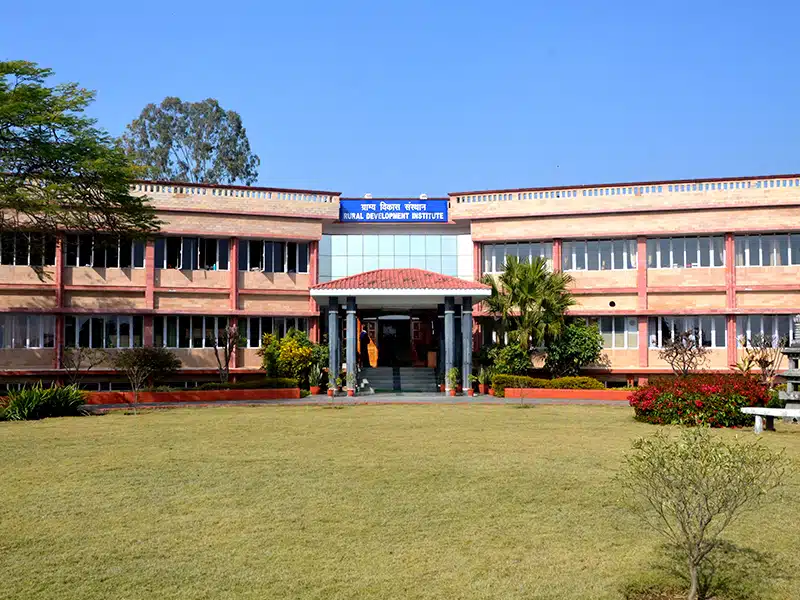
Reporting for Goal 17 is compiled by the SDG Cell from evidence supplied by the constituent colleges, the Rural Development Institute and the Registrar's Office. Corrections and additions are welcome.
Institutional Scope and Data Sources
The information presented in these reports draws upon the University's academic, healthcare, research and community outreach activities. It encompasses initiatives across the 200-acre campus at Jolly Grant, the 1,200-bed teaching hospital, telemedicine centres at Toli and Nagthat, and the WATSAN Department's sustained engagement with more than 550 villages since 1998. These institutional and community-level activities provide a comprehensive account of the University's contributions and initiatives.
 Planet
 People
 Partnership
 Health