
Industry, Innovation and Infrastructure
About this goal
At SRHU, innovation usually begins in a hospital ward or in the field rather than in a laboratory. In 2025, twenty-seven publications were classified under this goal. The University also reports patent activity, an incubation centre, and a technology transfer agreement, valid until 2034, which is intended to move research from the University into practical use.
How this goal is assessed
The Times Higher Education Impact Rankings assess Goal 9 against the 4 indicators below. The weighting shows each indicator's share of the score for this goal, and the evidence for each indicator is taken from the University's report.
Share of the Goal 9 score
-
9.1
Research on industry, innovation and infrastructure
- SRHU published 84 publications on industry, innovation and infrastructure during 2021–2025, including 27 published in 2025.
- These SDG 9 publications have a field-weighted citation impact (FWCI) of 2.13.
-
9.2
Patents
- Two SRHU publications from 2021–2025 were cited in patent applications, including United States application US 2024/0164419 A1 for a coconut-based essence composition.
- An SRHU review on nanotechnology in sustainable agriculture, published in Plant Nano Biology, is cited in international application WO 2026/062580 A1 filed by King Abdullah University of Science and Technology.
-
9.3
University spin-offs
- The SRHU innovation ecosystem includes seven registered companies and pre-startups, of which one holds a design right originating at the University.
- ULO Labs Private Limited, incorporated on 26 June 2024, holds UK Design 6501510, and its transfer from SRHU is in progress.
- Canfinis Therapeutics Private Limited, incorporated on 30 July 2021, remains active and holds three UK designs assigned to it.
-
9.4
Research income from industry
- In 2025, Medicine generated ₹1,37,78,400 in research income from industry and commerce, with 287 academic staff.
- In 2025, STEM generated ₹5,50,000 in research income from industry and commerce, with 34 academic staff.
- Arts and Humanities and Social Sciences, with 19 academic staff, reported no research income from industry and commerce in 2025.
Source · SRHU SDG 9 report, 2025. Indicator numbers and weightings follow the Times Higher Education Impact Rankings 2025 methodology.
What the year showed

The Food Project, a student-run pre-start-up incubated at the University, presents its products at its stall.
Source · SRHU SDG 9 report, 2025
Explore the evidence →Evidence by assessment area
Assessment covers four areas, namely research, teaching, outreach and stewardship. The reporting is arranged in the same way, so that a single piece of evidence can be cited directly without referring the reader to the whole report.
Research for Goal 9
Publications, projects, patents and research income attributed to this goal.
Teaching for Goal 9
Programmes, courses and training through which the goal enters the curriculum.
722 courses map to this goal →Outreach for Goal 9
Work with communities, agencies, industry and other institutions beyond the campus.
Stewardship for Goal 9
The University's own operations, including estates, policy, governance and employment.
The full 2025 report
The University's report for Goal 9, with all the evidence summarised above. PDF · 434.6 KB.
Goal-wise reports by year
Consolidated
Who maintains this page
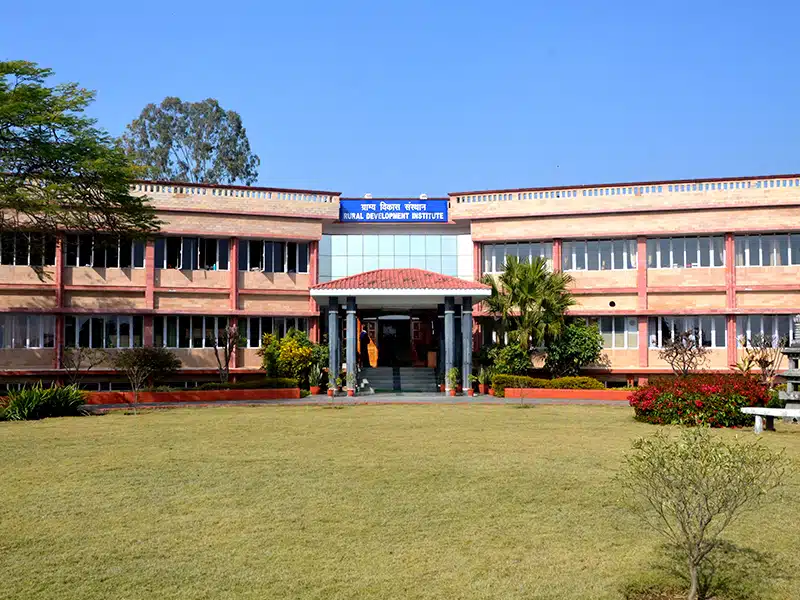
Reporting for Goal 9 is compiled by the SDG Cell from evidence supplied by the constituent colleges, the Rural Development Institute and the Registrar's Office. Corrections and additions are welcome.
Institutional Scope and Data Sources
The information presented in these reports draws upon the University's academic, healthcare, research and community outreach activities. It encompasses initiatives across the 200-acre campus at Jolly Grant, the 1,200-bed teaching hospital, telemedicine centres at Toli and Nagthat, and the WATSAN Department's sustained engagement with more than 550 villages since 1998. These institutional and community-level activities provide a comprehensive account of the University's contributions and initiatives.
 Planet
 People
 Partnership
 Health