

Affordable and Clean Energy
About this goal
A teaching hospital operates without interruption, and this requirement governs the University's approach to energy. For this reason, rooftop solar capacity has grown from 1,500 kWp in 2022–23 to 2,500 kWp in 2025, with generation planned for a load that never falls to zero.
How this goal is assessed
The Times Higher Education Impact Rankings assess Goal 7 against the 5 indicators below. The weighting shows each indicator's share of the score for this goal, and the evidence for each indicator is taken from the University's report.
Share of the Goal 7 score
-
7.1
Research on affordable and clean energy
- SRHU published 31 research publications on affordable and clean energy between 2021 and 2025, of which 11 were published in 2025.
- The University's 2021–2025 affordable and clean energy publications have an average Field-Weighted Citation Impact of 1.58.
-
7.2
Clean energy measures
- The Policy for Energy Conservation and Clean Energy Technology, in place since 2019 and reviewed in 2022, requires new buildings and major renovations to follow IGBC and LEED principles.
- The Plan for Reducing Overall Energy Consumption aims to cut campus energy consumption by 30–40% over five years through energy audits, LED lighting and optimised HVAC systems.
- In 2025, the University's certified carbon footprint was 3,312.33 tCO₂e, verified by Eco Science Consultancy, Uttarakhand, and its Net Zero Action Plan sets reduction targets to 2050.
-
7.3
Energy use
- In 2025, the University consumed 3,828,363 kWh of energy across a built-up area of 256,247.59 m², giving an Energy Performance Index of 14.94 kWh/m²/year.
- Energy consumption is monitored through regular energy audits, and the University holds an ISO 50001:2018 Energy Management System audit certificate.
-
7.4
Energy and the community
- The University ran an awareness programme on energy efficiency and clean energy for the local community of the Doiwala Municipal Council, confirmed by a letter from its Chairman.
- The University has made a public pledge to transition progressively to 100% renewable energy and promoted it through a community event on cleanliness and the pledge.
- In 2025, the Atal Community Innovation Centre, SRHU Innovation and Incubation Centre (ACIC-SIIC) incubated Mirage Energy R&D Pvt. Ltd., a start-up working on waste-to-energy, biofuels and renewable energy.
-
7.5
Low-carbon energy use
- In 2025, the University used 10,472.6 GJ of energy from low-carbon sources, namely solar and biogas.
- The University has installed 2,500 kWp of renewable energy capacity, which generated 2,909,058 kWh of electricity in 2025.
Source · SRHU SDG 7 report, 2025. Indicator numbers and weightings follow the Times Higher Education Impact Rankings 2025 methodology.
What the year showed

Rooftop solar arrays on campus form part of the 2,500 kWp installed capacity that generated 2,909,058 kWh of electricity in 2025.

The University's HVAC plant was installed to optimise thermal comfort and reduce energy consumption, one of its measures for energy efficiency.

Solar panels on campus rooftops supply renewable energy, which saved the University ₹1.09 crore on electricity in 2025.
Source · SRHU SDG 7 report, 2025
Explore the evidence →Change over three years
The same measures across the two preceding cycles, from the same report.
Source · SRHU SDG 7 report, 2025. Earlier cycles are also published as the 2023–24 goal report.
Evidence by assessment area
Assessment covers four areas, namely research, teaching, outreach and stewardship. The reporting is arranged in the same way, so that a single piece of evidence can be cited directly without referring the reader to the whole report.
Research for Goal 7
Publications, projects, patents and research income attributed to this goal.
Teaching for Goal 7
Programmes, courses and training through which the goal enters the curriculum.
118 courses map to this goal →Outreach for Goal 7
Work with communities, agencies, industry and other institutions beyond the campus.
Stewardship for Goal 7
The University's own operations, including estates, policy, governance and employment.
The full 2025 report
The University's report for Goal 7, with all the evidence summarised above. PDF · 1.7 MB.
Goal-wise reports by year
Consolidated
Who maintains this page
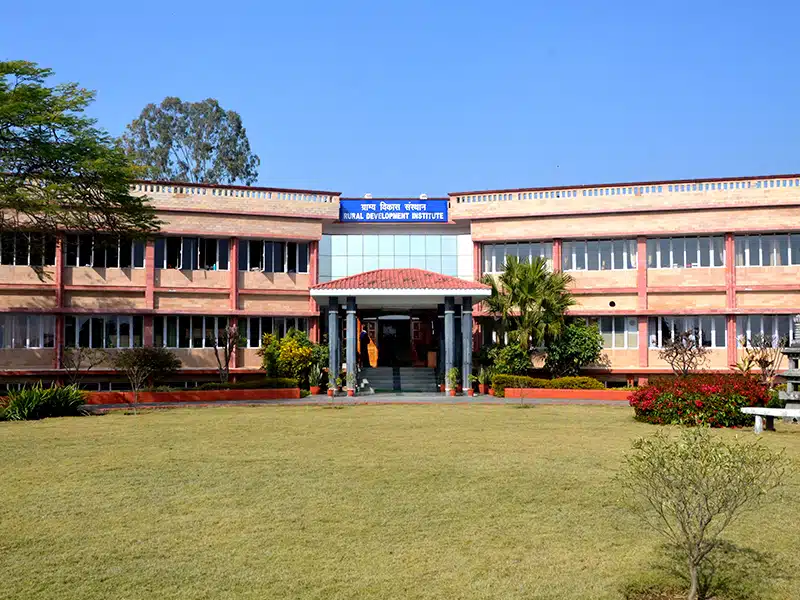
Reporting for Goal 7 is compiled by the SDG Cell from evidence supplied by the constituent colleges, the Rural Development Institute and the Registrar's Office. Corrections and additions are welcome.
Institutional Scope and Data Sources
The information presented in these reports draws upon the University's academic, healthcare, research and community outreach activities. It encompasses initiatives across the 200-acre campus at Jolly Grant, the 1,200-bed teaching hospital, telemedicine centres at Toli and Nagthat, and the WATSAN Department's sustained engagement with more than 550 villages since 1998. These institutional and community-level activities provide a comprehensive account of the University's contributions and initiatives.
 Planet
 People
 Partnership
 Health