

Zero Hunger
About this goal
The University addresses hunger in two settings. In the hospital, clinical malnutrition is treated as a medical condition. In the villages of the practice area, the crops that a household can grow determine what it can eat and what it can sell. For this reason, the University's work under this goal includes livelihood training for farmers as well as nutrition kits for patients with tuberculosis and for anaemic pregnant women.
How this goal is assessed
The Times Higher Education Impact Rankings assess Goal 2 against the 5 indicators below. The weighting shows each indicator's share of the score for this goal, and the evidence for each indicator is taken from the University's report.
Share of the Goal 2 score
-
2.1
Research related to hunger
- The University published 55 research papers related to hunger in 2021–2025, of which 22 were published in 2025.
- SDG 2 publications from 2021–2025 achieved a Field-Weighted Citation Impact (FWCI) of 1.23.
-
2.2
Campus food waste
- The Policy for Reducing Food Wastage, in place since 2019, requires annual measurement of food waste from dining halls, hostels, kitchens, canteens and guest houses.
- In 2025, the University measured and processed 49.25 tons of food waste, equal to 0.005 metric tons per person for a campus population of 9,862.
- Campus food waste is converted into clean cooking fuel in an on-campus anaerobic biogas plant and into organic manure in institutional composting units.
-
2.3
Student hunger
- Hostel mess and cafeteria facilities operate at subsidised rates, and faculty mentors and hostel wardens identify students who may be skipping meals because of economic constraints.
- The Policy for Sustainably Farmed Food on Campus requires vegetarian and vegan options to be offered daily at all campus dining outlets.
- The Employee Welfare Fund supports staff experiencing financial hardship or temporary food insecurity, and subsidised meals are provided for faculty and non-teaching staff.
-
2.4
Proportion of graduates in food sustainability
- The University does not offer degree programmes in agriculture or aquaculture, so it has no graduates to report under this indicator.
-
2.5
National hunger
- Through the Comprehensive Community Development Programme, agronomists train farmers in Toli and Malethi, Pauri Garhwal, to grow climate-resilient crops such as ginger, turmeric and traditional millets.
- Under a direct buy-back model, the University purchased 20.35 quintals of turmeric, garlic, chilli, ragi and ginger from Comprehensive Community Development Programme farmers at fair market prices.
- In 2025, the University restored 4.374 acres of barren land in Malethi into productive farmland and distributed 150 temperate climate apple saplings to local farmers.
Source · SRHU SDG 2 report, 2025. Indicator numbers and weightings follow the Times Higher Education Impact Rankings 2025 methodology.
What the year showed

Campus food waste is converted into clean cooking fuel at the University's on-campus biogas plant; 49.25 tonnes of food waste were processed in 2025.

A health worker uses a sling scale during a home visit; 3,204 pregnant and lactating women were followed up through home visits in 2025.

Ginger and turmeric from programme farmers dry in a polyhouse; the University bought 20.35 quintals of such cash crops directly from farmers in 2025.

Planting pits are prepared on reclaimed hillside land at Malethi, where 4.374 acres of barren land were brought under cultivation in 2025.
Source · SRHU SDG 2 report, 2025
Explore the evidence →Evidence by assessment area
Assessment covers four areas, namely research, teaching, outreach and stewardship. The reporting is arranged in the same way, so that a single piece of evidence can be cited directly without referring the reader to the whole report.
Research for Goal 2
Publications, projects, patents and research income attributed to this goal.
Teaching for Goal 2
Programmes, courses and training through which the goal enters the curriculum.
172 courses map to this goal →Outreach for Goal 2
Work with communities, agencies, industry and other institutions beyond the campus.
Stewardship for Goal 2
The University's own operations, including estates, policy, governance and employment.
The full 2025 report
The University's report for Goal 2, with all the evidence summarised above. PDF · 3.3 MB.
Goal-wise reports by year
Consolidated
Who maintains this page
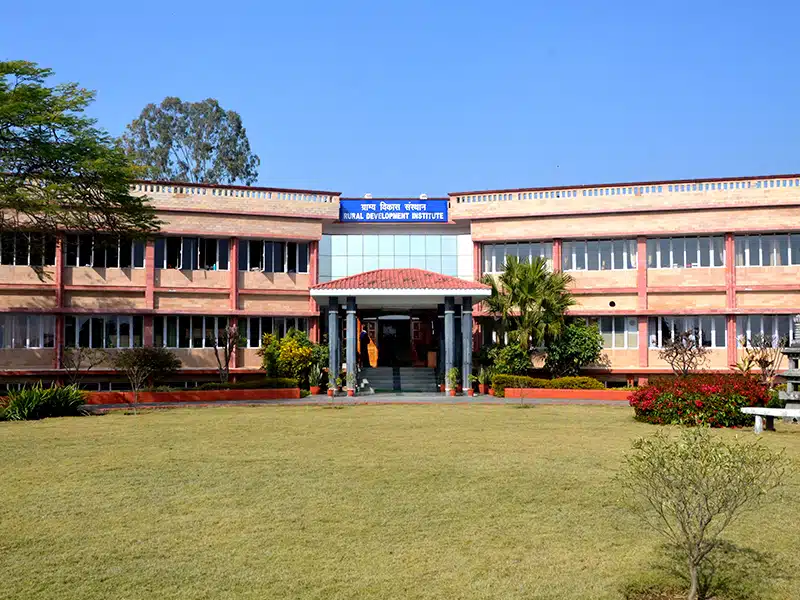
Reporting for Goal 2 is compiled by the SDG Cell from evidence supplied by the constituent colleges, the Rural Development Institute and the Registrar's Office. Corrections and additions are welcome.
Institutional Scope and Data Sources
The information presented in these reports draws upon the University's academic, healthcare, research and community outreach activities. It encompasses initiatives across the 200-acre campus at Jolly Grant, the 1,200-bed teaching hospital, telemedicine centres at Toli and Nagthat, and the WATSAN Department's sustained engagement with more than 550 villages since 1998. These institutional and community-level activities provide a comprehensive account of the University's contributions and initiatives.
 Planet
 People
 Partnership
 Health