
Peace, Justice and Strong Institutions
About this goal
Under this goal, the University reports on its own governance. Its policies are published together with the name of the approving body and the year of the last review. In January 2025, the University began a five-week training programme in bioethics and Good Clinical Practice, conducted with ICMR and DHR, for 100 clinical faculty members across four medical colleges.
How this goal is assessed
The Times Higher Education Impact Rankings assess Goal 16 against the 4 indicators below. The weighting shows each indicator's share of the score for this goal, and the evidence for each indicator is taken from the University's report.
Share of the Goal 16 score
-
16.1
Research on peace and justice
- SRHU published 14 research papers aligned with SDG 16 during 2021–2025, according to the University's Scopus export.
- Five of these SDG 16 publications appeared in 2025, including a study of medical students' views on rising violence against doctors in Uttarakhand.
- The SDG 16 publications for 2021–2025 have received 41 citations.
-
16.2
University governance measures
- Faculty and non-teaching staff sit on SRHU's Board of Governors and Board of Management, and students sit on bodies including the Students' Council and Students' Grievance Redressal Committee.
- SRHU's Students' Council has 20 members, including its office bearers, although the University has no formally elected Student Union.
- SRHU publishes its Anti-Bribery and Corruption Policy and its balance sheet for 2025 on the University website.
-
16.3
Working with government
- Vice Chancellor Dr Rajendra Dobhal co-chairs the NASI Uttarakhand Chapter, and Prof. Ashok Kumar Deorari, Principal of HIMS, has been nominated to the PGIMER Institute Body.
- With the State Water and Sanitation Mission, Government of Uttarakhand, SRHU trained public health engineers and government officials under the Jal Jeevan Mission.
- On 21–22 March 2025, SRHU hosted PAFMATCON 2024–25, the 22nd Annual Conference of the Punjab Academy of Forensic Medicine and Toxicology, for approximately 300 delegates.
-
16.4
Proportion of graduates in law and civil enforcement
- The University does not offer programmes in law or civil enforcement, so it has no graduates to report under this indicator.
Source · SRHU SDG 16 report, 2025. Indicator numbers and weightings follow the Times Higher Education Impact Rankings 2025 methodology.
What the year showed
Source · SRHU SDG 16 report, 2025
Explore the evidence →Evidence by assessment area
Assessment covers four areas, namely research, teaching, outreach and stewardship. The reporting is arranged in the same way, so that a single piece of evidence can be cited directly without referring the reader to the whole report.
Research for Goal 16
Publications, projects, patents and research income attributed to this goal.
Teaching for Goal 16
Programmes, courses and training through which the goal enters the curriculum.
241 courses map to this goal →Outreach for Goal 16
Work with communities, agencies, industry and other institutions beyond the campus.
Stewardship for Goal 16
The University's own operations, including estates, policy, governance and employment.
The full 2025 report
The University's report for Goal 16, with all the evidence summarised above. PDF · 4.1 MB.
Goal-wise reports by year
Consolidated
Who maintains this page
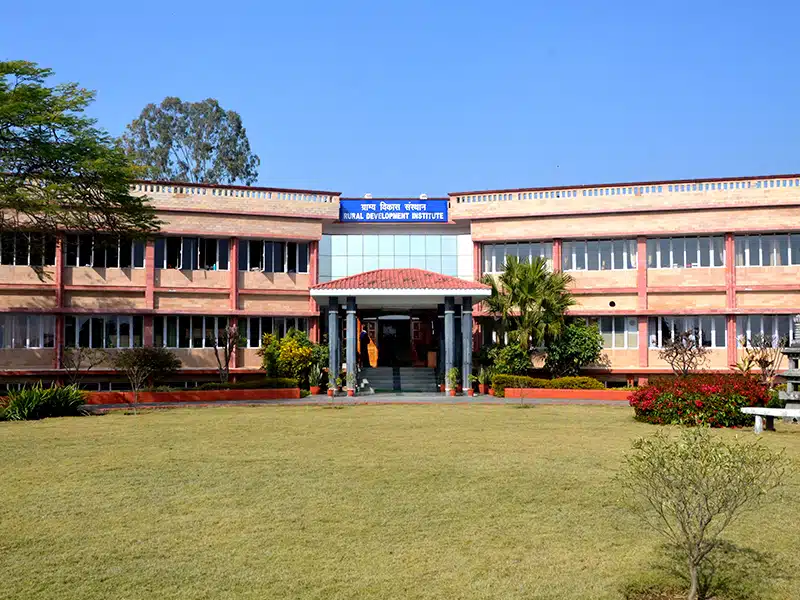
Reporting for Goal 16 is compiled by the SDG Cell from evidence supplied by the constituent colleges, the Rural Development Institute and the Registrar's Office. Corrections and additions are welcome.
Institutional Scope and Data Sources
The information presented in these reports draws upon the University's academic, healthcare, research and community outreach activities. It encompasses initiatives across the 200-acre campus at Jolly Grant, the 1,200-bed teaching hospital, telemedicine centres at Toli and Nagthat, and the WATSAN Department's sustained engagement with more than 550 villages since 1998. These institutional and community-level activities provide a comprehensive account of the University's contributions and initiatives.
 Planet
 People
 Partnership
 Health